CLASSROOM ACCESS · US & ENGLAND
Quick answer: The best sensory tools for neurodivergent learners are not necessarily the most expensive. Start with the actual barrier to participation: unwanted noise, uncomfortable seating, unpredictable transitions, a need for movement or tactile input. Ear defenders, quiet fidgets, visual supports and simple seating adjustments are sensory tools and access supports to trial with student input. No single product works for everyone, and “OT-informed” does not mean occupational-therapist approved.
Autistic learners, students with ADHD and other neurodivergent children can have very different sensory preferences. One student welcomes tactile input; another finds the same texture distressing. Sensory tools should offer access and agency rather than demand silence, stillness or compliance. Before shopping, see our sensory-friendly classroom setup guide for low-cost changes to noise, lighting and routines.
In this guide
How Occupational Therapists Think About Sensory Tools
Occupational therapy focuses on meaningful participation in everyday activities. Sensory tools and other classroom aids should make a specific task more comfortable or accessible: listening to directions, joining a group, writing, moving between lessons or recovering from overload. The American Occupational Therapy Association advises against delivering individualized sensory-based interventions without documented assessment of sensory-processing difficulties.
That guidance does not mean a teacher needs a medical assessment before moving a noisy chair or offering a visual timetable. It means professionals should not prescribe specialized sensory treatment on the strength of a diagnosis or marketing promise alone. The Royal College of Occupational Therapists similarly emphasizes clinical reasoning, consent, risk assessment and measurable participation outcomes.
A 2025 systematic review found mixed evidence for many sensory techniques. Among its findings, alternative seating did not consistently improve attention, and one fidget-spinner study reported worse attention-related outcomes. This is why our recommendations below are practical options, not claims that equipment cures or treats a condition.
Sensory tools at a glance: match support to the barrier
| Barrier or preference | Tool to consider | Check before buying |
|---|---|---|
| Unpredictable or intense sound | Ear defenders | Comfort, appropriate hearing access, occasional use |
| Hands need optional movement | Quiet fidget | Low distraction, washable, age-appropriate |
| Transitions feel uncertain | Visual schedule or timer | Clear symbols, non-alarming cues |
| Feet lack stable support | Non-slip footrest | Chair fit, stability and accessibility |
| Movement supports comfort | Secured chair band; movement cards | Safety, teacher sightlines, student preference |
| Busy spaces or touch feel overwhelming | Quiet-space kit; texture choices | Voluntary access, hygiene, sensory preferences |
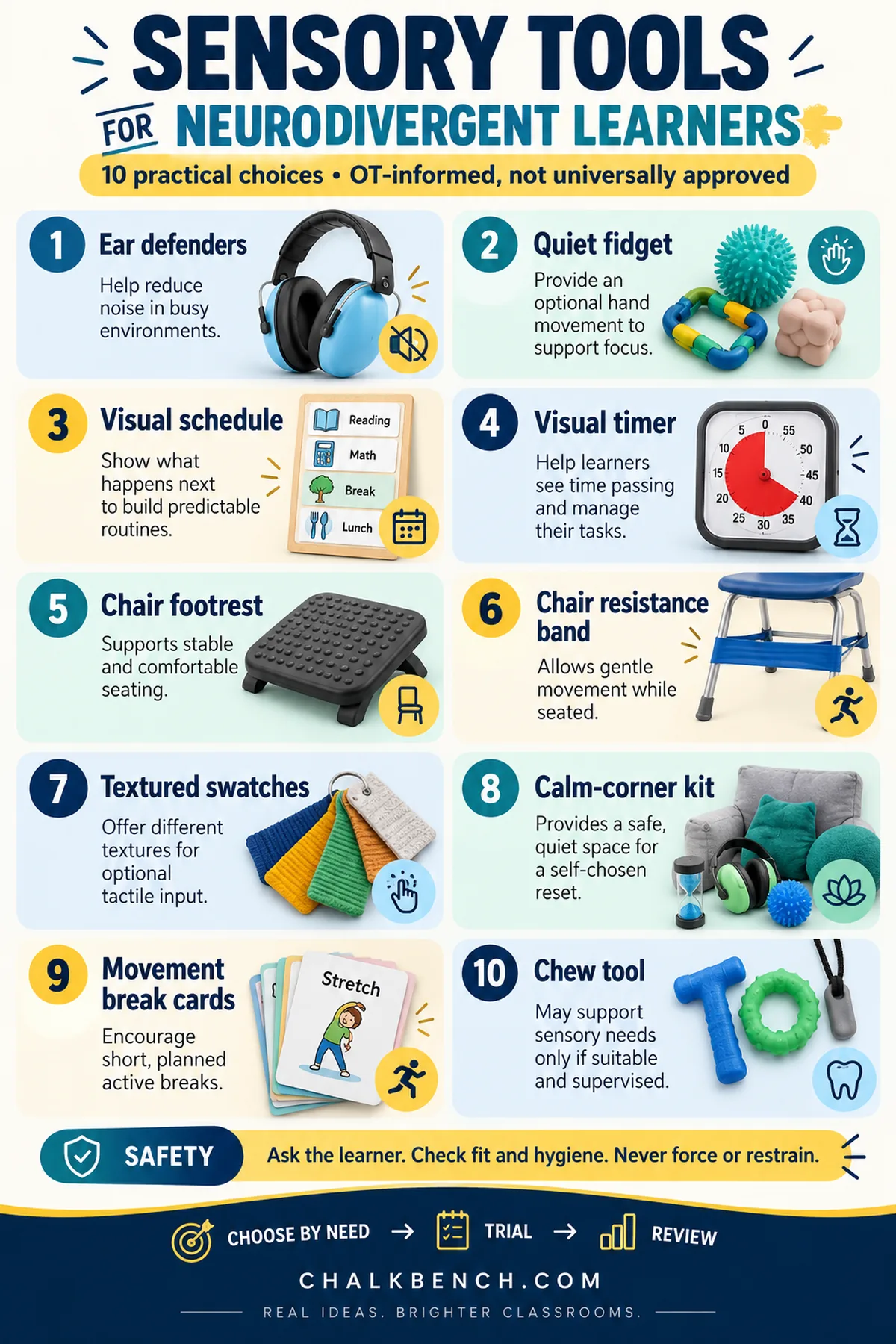
10 Sensory Tools Worth Considering for Classrooms
1. Ear Defenders for Predictably Noisy Moments
Best fit: A child who finds assemblies, the cafeteria or particular classroom activities painfully loud. Over-ear defenders are straightforward to fit and remove and do not need a connected device. Compare padding, weight, adjustability and whether the child can still hear essential instructions and safety alerts.
As with other sensory tools, offer them as an accessible option, not a blanket requirement. Some students prefer a quiet seat or advance warning instead. Somerset NHS guidance cautions that everyday, prolonged use of ear defenders may be counterproductive for some children. Agree when to use them and how to communicate during use.
2. Quiet Hand Fidgets That Do Not Become Another Distraction
Best fit: A learner who chooses small, repetitive hand movements while listening. Look for a silent, durable item such as a soft squeeze ball or discreet tactile ring. Offer two choices and ask which, if either, feels useful.
A spinning, flashing or clicking toy may attract more attention than it supports. A fidget is a choice for self-regulation, not an earned reward or a test of “good behaviour.” Check for detachable small parts and keep shared objects clean. Judge these sensory tools by comfort and participation, not whether the child stops moving.
3. Reusable Visual Schedule Cards
Best fit: Students who benefit from knowing what happens now, next and later. A simple set of picture or text cards can show lessons, changes, transitions and breaks. Lamination and hook-and-loop dots are optional; a paper timetable can be equally useful.
Review the schedule at the beginning of the day and flag changes before they happen. Use age-respectful language for older learners. Visual routines complement sensory tools by supporting predictability rather than directly changing sensory processing. CAST’s UDL Guidelines recommend previews and routines to reduce avoidable barriers.
4. Visual Timers With Gentle Cues
Best fit: Learners who want a concrete picture of how long a task or break will last. Consider a silent countdown, color-changing timer or plain time strip. A loud alarm can create the very distress the tool is meant to prevent, so choose an unobtrusive end signal.
Invite the child to help choose a workable duration. For example, a visible five-minute warning can prepare everyone for tidy-up without surprising a learner who finds abrupt transitions difficult. A timer is an organizational support; it is not evidence of improved sensory integration.
5. Stable Footrests and Better Desk Fit
Best fit: Students whose feet dangle from the chair or who shift repeatedly to find comfortable support. A sturdy, non-slip footrest is often less complicated than purchasing a specialist chair. Check the full workstation: feet supported, writing surface within reach, stable chair and freedom to change position.
A footrest should not trap legs, obstruct an exit or prevent a wheelchair user from positioning safely. Ask whether comfort or participation improves; do not assume that better posture automatically creates better concentration.
6. Chair Resistance Bands for Optional Leg Movement
Best fit: A learner who enjoys gentle foot movement while seated. A purpose-designed, securely fitted band can provide a discreet option in some classrooms. Confirm that the chair is compatible, the band cannot snap into anyone’s path and the student can stop whenever they want.
Treat chair bands as sensory tools to trial; attention benefits are not guaranteed. Observe whether the student can continue participating and whether the movement disturbs classmates or creates a trip hazard. If safety, fit or supervision is uncertain, choose a scheduled movement break instead.
7. Small, Washable Texture Samples
Best fit: Learners who voluntarily explore fabric or surface textures to feel comfortable. A few cloth swatches in distinct textures can cost very little; let the student select preferred and disliked materials. Do not require touching as a “desensitization” exercise.
Use non-shedding, washable materials and avoid strong scents, loose beads and surfaces that irritate skin. Some children avoid touch and will not benefit from a texture kit at all. The student’s stated preference matters more than the number of textures in the box.
8. A Simple Calm-Corner Kit
Best fit: A child who needs a predictable place to reduce sensory demands. Start with an ordinary chair or soft seat, visual break card, water access where permitted and a small selection of preferred quiet items. Position it within school safeguarding and supervision rules.
The space must be voluntary, accessible and never used as punishment or seclusion. Agree how a child asks for a break and returns when ready. Before buying a tent or elaborate “sensory pod,” try a calmer position in the room, softened glare or a quieter transition route.
9. Movement-Break Choice Cards
Best fit: Children who benefit from opportunities to stand, stretch, walk or change body position. Cards might offer wall pushes, a short hallway walk under supervision or carrying ordinary classroom materials when appropriate. They cost almost nothing to print.
Let the learner choose; do not force “heavy work” or prescribe a particular intensity without individual advice. Build movement into the class routine so it does not single out one child. The goal is better access and comfort when returning to a meaningful activity.
10. Individual Chew Tools — With Extra Safeguards
Best fit: A learner who persistently seeks oral input and for whom an appropriate chew item has been identified with family and professional input. Choose only a product designed for this purpose and suitable for the student’s age, bite strength and health needs.
Inspect for damage, follow replacement and cleaning instructions, never share between children and consider choking, infection-control and supervision risks. Neck cords and detachable parts may be unsuitable. Ordinary jewelry, stationery or DIY silicone shapes are not safe substitutes. If a child is chewing hazardous objects, seek individualized assessment rather than buying an item at random.
What About Weighted Blankets, Lap Pads and Weighted Vests?
These items deserve a separate decision, not a casual place on a classroom shopping list. Evidence for deep-pressure approaches is not equivalent to proof that a particular blanket or vest improves classroom attention. Risks include restricted movement, overheating, breathing difficulties and using weight to control a child’s behaviour.
The RCOT provides specific weighted-blanket guidance covering consent, assessment, risks and monitoring. Somerset NHS stresses that a child must be able to free themselves and that weighted equipment must never be used as restraint. For a classroom purchase, involve the school’s occupational therapist or responsible clinical professional and follow school policy; do not improvise a weight formula.
How to choose sensory tools without wasting the budget
- Name the real barrier. “The cafeteria is too loud” is more actionable than “this student needs sensory input.”
- Ask the learner privately. Explain available options and respect refusal or a changed preference.
- Try the environmental fix first. Reduce glare, scraping chairs, crowding or confusing routines before purchasing equipment.
- Choose one low-risk trial. Agree a purpose, usage times, safety checks and who will maintain the item.
- Review participation. Compare how comfortable the child felt and whether they could access the intended activity; do not measure success by quietness alone.
For example, if a student avoids morning assembly, test a quieter entry point or reserved seat first. If noise remains the barrier, agree a brief trial of well-fitting ear defenders. Ask the student afterwards whether assembly felt more manageable and adjust the plan rather than buying a full “sensory bundle.”
A two-week classroom trial for sensory tools
Days 1–2: Speak with the learner and family, establish one functional goal and note triggers. Days 3–7: Introduce one option with clear safety expectations. Keep a short record of student-rated comfort, access to the target activity and any problems. Days 8–10: Review with the learner. Keep, adapt or stop the tool based on what actually happened.
This sensory tools trial is a practical suggestion, not a clinical protocol or mandatory waiting period. Seek specialist help promptly when there are injuries, persistent distress, unsafe chewing, restrictive equipment concerns or significant barriers to attendance or learning. In the US, discuss access needs with the IEP or Section 504 team as appropriate; in England, discuss SEN Support and reasonable adjustments with the SENCO. Sensory tools do not replace an agreed support plan. Our IEP vs. 504 plan guide explains the different US support routes.
If adapting lesson materials is also necessary, read ChalkBench’s guide to differentiated instruction tools. Keep the learning objective consistent while reducing unnecessary barriers.
Sensory tools: common mistakes to avoid
- Buying by diagnosis: Two autistic students may need completely different supports.
- Calling a product “OT approved”: Marketing language is not an independent evaluation.
- Assuming a fidget improves focus: Evidence is mixed and the student’s own experience matters.
- Using equipment to suppress harmless stimming: Respect communication, autonomy and comfort.
- Ignoring maintenance: Check hygiene, damage, batteries, fit and classroom storage.
- Overlooking ordinary changes: Quiet seating, clearer instructions and movement opportunities may matter more than purchases.
Sensory tools: frequently asked questions
What is the best sensory tool for an autistic student?
There is no universally best product. Identify the student’s preferred and difficult sensory experiences, then consider practical accommodations such as a quiet space, reduced glare or optional ear defenders. Individual choice and outcomes guide the decision.
Do fidget toys help students with ADHD focus?
Some students prefer quiet fidgets, but research does not show that fidgets reliably improve focus for everyone. One 2025 evidence review reported an unfavorable attention finding for a fidget-spinner study. Trial discreetly and review rather than assuming a benefit.
Are noise-cancelling headphones better than ear defenders?
Not automatically. Fit, comfort, school safety and the activity matter more than a product label. The research base is limited; one small study in a broader systematic review reported improved auditory-related participation with earmuffs, while noise-cancelling headphones did not show a significant improvement in that study. This does not establish general superiority. Ask what the child can hear when wearing either option.
Can a school offer sensory accommodations without a diagnosis?
Many ordinary access adjustments can be made based on identified needs. Formal responsibilities, documentation and specialist service access differ across US jurisdictions and English schools; discuss persistent barriers with the student’s support team rather than delaying classroom-level improvements.
Are wobble cushions proven to improve attention?
The cited review does not establish a reliable attention benefit. It found no significant attention improvement in the alternative-seating studies it included; this does not prove every cushion ineffective. A cushion might still feel more comfortable for an individual student, but comfort and attention are different outcomes.
Should every classroom have a sensory corner?
Not necessarily. A designated quiet space may help, but it must be voluntary, safe and accessible. Some students prefer a quieter seat, an exit card or a short supervised break. Review what works rather than building an elaborate corner by default.
Are weighted blankets suitable for classroom use?
Not as a routine purchase or behavior-management device. They require careful assessment of consent, safety, physical needs and monitoring. Refer to occupational therapy and the RCOT’s guidance; never use weighted items to restrain a child.
Choose sensory tools around participation
Start with the child, not the catalogue. The strongest classroom decision is often a small environmental adjustment, a voluntary support and a simple follow-up question: “Did this make the activity easier for you?” Choose sensory tools for neurodivergent learners with care, keep their learning goals meaningful and change the plan when the tool does not help.
References and Further Reading
- American Occupational Therapy Association — Sensory Integration & Processing
- Royal College of Occupational Therapists — Sensory Approaches (including 2026 guidance)
- Piller et al. (2025) — Systematic Review of Sensory-Based Interventions
- NELFT NHS Foundation Trust — Understanding Sensory Processing
- National Autistic Society — Sensory Adjustments in Schools
- CAST — Address Biases, Threats and Distractions
- Somerset NHS — Weighted Blanket Safety
ChalkBench Editorial · M. Danish · Updated October 21, 2026. Evidence-informed educational guidance; not an individual clinical assessment or product endorsement.