
US Special Education & Parent Rights
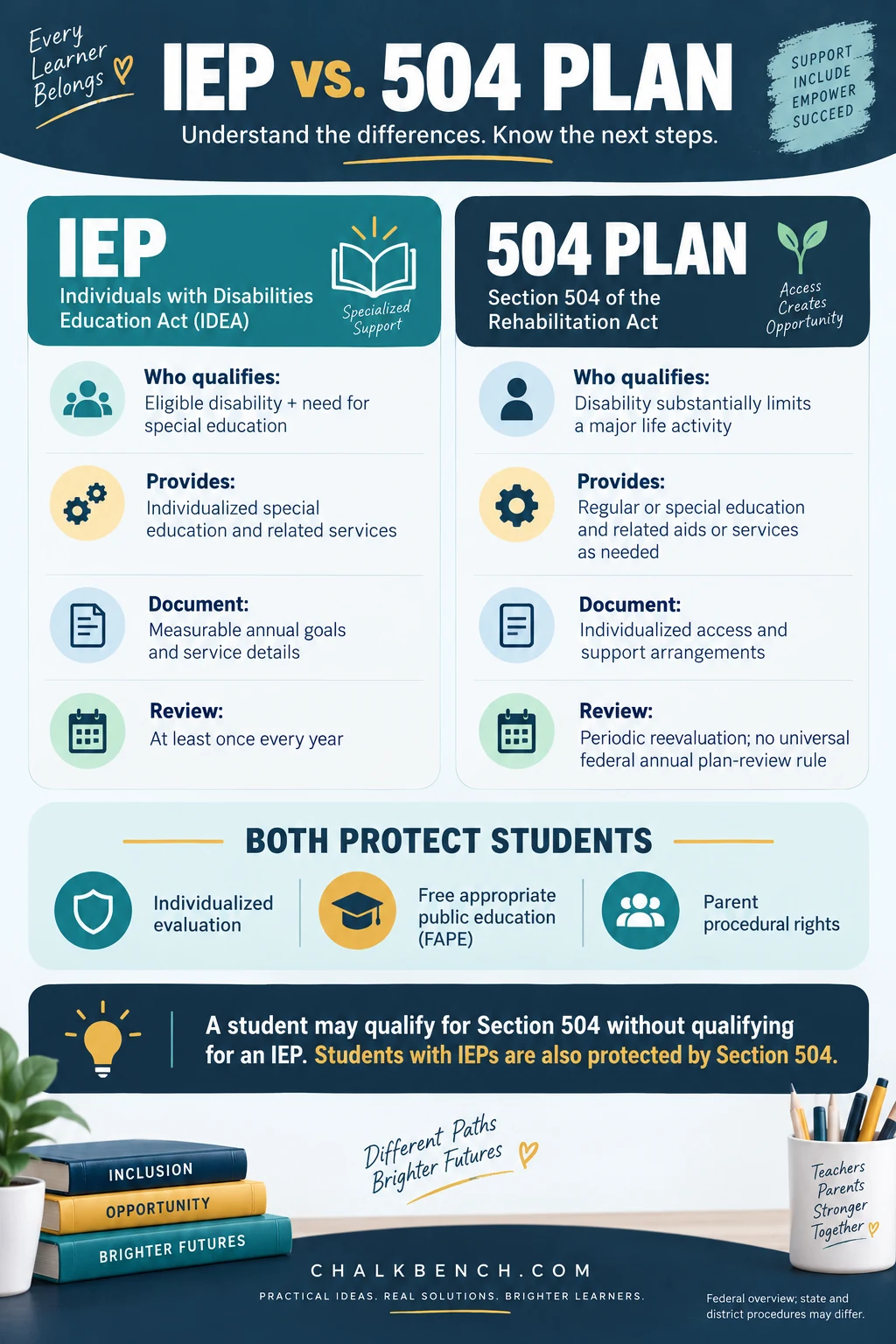
IEP vs. 504 Plan: what is the difference? An Individualized Education Program (IEP) is developed under the Individuals with Disabilities Education Act (IDEA) for a child who meets IDEA eligibility criteria and needs special education. A Section 504 plan is a common way schools document the aids, services, and adjustments a qualified student needs under Section 504 of the Rehabilitation Act. Section 504 has a broader disability standard, and students do not have to need special education—or have failing grades—to be protected.
When comparing IEP vs. 504 Plan options, both routes can make school safer, more accessible, and more effective. Neither is a prize to win, and one is not automatically “better.” The useful question is what does your child need to participate in school and receive an appropriate education? This practical guide explains eligibility, services, timelines, parent rights, and the next steps you can take with your school.
Quick takeaway: Think IEP = special education and an individualized educational program; think Section 504 = disability-related access and the regular or special education and related aids or services needed for FAPE. Both may include accommodations and related services. An IEP can satisfy Section 504 FAPE requirements, so schools generally do not need to issue a second, separate 504 plan for a student receiving an appropriate IEP.
In this guide
IEP vs. 504 Plan: side-by-side comparison
Use this IEP vs. 504 Plan comparison table as a starting point before your next school meeting. It summarizes federal requirements for public elementary and secondary education; state rules and district procedures can add detail.
| Question | IEP under IDEA | Section 504 / 504 plan |
|---|---|---|
| Federal law | Individuals with Disabilities Education Act (IDEA) | Section 504 of the Rehabilitation Act of 1973; ADA Title II may also apply to public schools |
| Basic eligibility | An IDEA-recognized disability and a need for special education and related services | A physical or mental impairment that substantially limits a major life activity; the eligibility standard is broader |
| Core purpose | Provide an individualized special education program and FAPE | Prevent disability discrimination and provide FAPE, meaningful access, and needed aids/services |
| Specialized teaching | Yes, when specified by the IEP | Not required for every eligible student, but Section 504 can require special education and related aids or services when needed |
| Accommodations | May be included alongside special education services | Often central to the plan; not the only support Section 504 allows |
| Required document | Formal written IEP with specified components, including measurable annual goals | Typically a written 504 plan; federal Section 504 regulations do not prescribe the same IEP-format document |
| School review | IEP reviewed at least annually; reevaluation generally at least every three years unless waived by agreement | Periodic reevaluation and review when circumstances warrant; no universal federal rule requiring an annual 504-plan meeting |
| Parent protections | IDEA notice, participation, consent, records access, mediation, complaints, and due process rights | Notice, access to records, impartial hearing and review procedures; OCR discrimination complaint avenue |
| School success | Good grades alone do not resolve whether a child needs special education | Good grades do not rule out Section 504 eligibility; a limitation may involve more than learning |
Key federal references: IDEA disability eligibility, IEP required components, and U.S. Department of Education disability FAQ.
What is an IEP?
An Individualized Education Program is a legally required written educational plan for a student found eligible under IDEA. It is not simply a list of classroom tips. The IEP describes the child’s current academic and functional performance, measurable annual goals, special education and related services, accommodations and supports, and how progress will be measured and reported.
IDEA eligibility involves two linked findings: the child meets criteria for a recognized disability category and, because of that disability, needs special education and related services. Categories include autism, specific learning disabilities, speech or language impairments, and other health impairments, among others. For instance, ADHD may be considered within IDEA’s “other health impairment” framework when the legal criteria and need for special education are met; the label alone does not automatically qualify a child.
What could an IEP look like in practice?
Consider a student with significant reading difficulties whose evaluation demonstrates a specific learning disability and a need for specially designed reading instruction. An IEP might provide an explicit reading intervention delivered by trained staff, a measurable decoding goal, scheduled progress monitoring, and classroom accommodations so the student can access grade-level content.
For parents comparing IEP vs. 504 Plan routes, the IEP team includes parents and required school representatives. It must consider the child’s strengths, the parents’ concerns, evaluation information, and academic, developmental, and functional needs. By regulation, the team must review the IEP at least once a year and revise it when needed—for example, if a student is not making expected progress. See 34 CFR § 300.324.
What is a Section 504 plan?
Section 504 is a federal civil rights law that prohibits disability discrimination in programs receiving federal financial assistance. Its education rules require public schools covered by the law to provide a free appropriate public education (FAPE) to qualified students with disabilities. A school commonly documents the student’s individualized access arrangements and services in a 504 plan.
A student can be eligible when a physical or mental impairment substantially limits one or more major life activities. These activities can include reading, concentrating, breathing, walking, caring for oneself, and major bodily functions. Importantly, learning does not need to be the specific activity that is substantially limited. A high-achieving student with a significant health-related impairment may still need supports.
A 504 plan might describe access to medication or health services, reduced-distraction testing, accessible school spaces, adjustments to attendance procedures where warranted, assistive technology, or other individualized aids. It can also include services people associate with special education, such as occupational therapy or counseling, when these are necessary to meet the student’s educational needs under Section 504. It is therefore inaccurate to say, “An IEP provides services, but a 504 plan provides only accommodations.”
Unlike IDEA, federal Section 504 regulations do not mandate a particular IEP-style written document with measurable annual goals. Schools generally use written plans because clarity helps everyone implement a student’s supports consistently. For more on the scope of services, read the U.S. Department of Education’s disability-discrimination FAQ.
IEP vs. 504 Plan eligibility: who qualifies?
When comparing IEP vs. 504 Plan eligibility, the difference in eligibility matters more than the diagnosis on a medical form. IDEA looks at a recognized disability and the child’s need for special education. Section 504 looks more broadly at whether a physical or mental impairment substantially limits a major life activity. Both require individualized evaluation and decisions; schools should not rely on blanket policies or test scores alone.
Scenario 1: ADHD with strong grades but meaningful barriers
A student earns above-average grades but spends hours recovering from school demands, struggles with organization, and experiences substantial difficulty concentrating. Good grades do not automatically disqualify the child from Section 504 consideration. A team should examine how the impairment affects school participation and major life activities, including the impact of supports already being used. If the student needs specially designed instruction and satisfies IDEA criteria, the school should also consider an IDEA evaluation.
Scenario 2: Dyslexia and a need for explicit reading instruction
A child demonstrates persistent difficulties decoding words despite appropriate classroom instruction. If a comprehensive evaluation establishes an IDEA-recognized specific learning disability and a need for specialized reading instruction, an IEP may be appropriate. If IDEA eligibility is not established, the school must still consider applicable Section 504 protections and individualized supports rather than assuming that no assistance is available.
Scenario 3: Diabetes that affects safety and school access
A student may follow the general curriculum successfully but need a coordinated plan for blood-glucose monitoring, snacks, field trips, and emergency responses. Section 504 may be relevant even without a need for specially designed academic instruction. A health plan and a 504 plan can serve complementary purposes; neither should be confused with a one-size-fits-all checklist.
Important: These are illustrative scenarios, not individualized eligibility determinations. A diagnosis by itself neither guarantees a plan nor justifies a school refusing to evaluate where a disability is suspected. The Office for Civil Rights explains that a medical diagnosis is not necessarily required for a Section 504 evaluation, and schools must not shift the cost of an assessment they determine necessary to parents. See the federal FAQ on school evaluations.
IEP vs. 504 Plan services: what support can each include?
Parents comparing IEP vs. 504 Plan support often search for a list of “IEP accommodations vs. 504 accommodations.” Some supports appear in both. The deciding factor should be the child’s evaluated needs and applicable legal eligibility—not whether a service happens to be on a popular printable list.
Examples that might appear in an IEP
- Specially designed instruction in reading, writing, math, communication, or functional skills.
- Measurable annual goals and a schedule for monitoring progress.
- Speech-language or occupational therapy where required as related services.
- Assistive technology, accessible materials, positive behavioral supports, and testing accommodations.
- Details on frequency, location, duration, and responsible services.
Examples that might appear in a Section 504 plan
- Extended time or a reduced-distraction setting when an individualized evaluation supports the need.
- Access to medication, school nursing, hydration, breaks, and disability-related health supports.
- Accessible classroom locations, field-trip arrangements, or adapted school procedures.
- Assistive technology, counseling, therapy, or other aids and services where necessary for FAPE.
- Clear communication about which school staff implement each support and how concerns are escalated.
In an IEP vs. 504 Plan comparison, these are possibilities, not automatic entitlements. Ask your team to explain how every recommended support connects to the student’s actual school-day barriers. Also ask whether the support will work during recess, assemblies, transportation, sports, testing, and field trips—not only during the first period of class.
For educators adapting materials alongside a formal support plan, ChalkBench also explains how to review AI tools for differentiated instruction. Technology can help draft accessible resources, but it does not replace an IEP, a Section 504 decision, or professional judgment.
How do evaluation timelines and meetings differ?
The IDEA/IEP route
Either a parent or a public agency may initiate a request for an IDEA initial evaluation. Under the federal rule, that evaluation is generally completed within 60 days after parental consent, unless the state has established its own timeline; specified exceptions also exist. If the child is found eligible, the initial IEP meeting must take place within 30 days of the eligibility determination. Parents have the right to participate in the eligibility decision and IEP process. See 34 CFR § 300.301 and § 300.323.
The team must review an IEP at least annually. IDEA reevaluation generally occurs at least every three years unless the parent and school agree it is unnecessary, and can be triggered sooner when educational needs warrant it. State-specific procedural rules may affect the practical calendar.
The Section 504 route
On the Section 504 side of an IEP vs. 504 Plan comparison, a knowledgeable group considers information from multiple sources and evaluates whether the child has a qualifying disability and what aids or services are needed. OCR interprets Section 504 as requiring parental permission for an initial evaluation. There is no single nationwide 60-day 504 evaluation deadline or federal requirement that all 504 plans receive an annual meeting, but schools must evaluate students appropriately and periodically reevaluate them. Check the district’s published procedures and applicable state rules.
Do not let an informal intervention plan, RTI, or MTSS become a reason to indefinitely delay a disability evaluation when the school has reason to suspect that a student needs one. General education supports and disability evaluation can proceed in parallel where appropriate.
How to request an IEP or 504 evaluation: a parent action plan
- Describe the barriers, not just the label. Gather work samples, attendance or health records, teacher messages, observations, and relevant clinical documents you already have. Explain what happens at school, when, and how it affects learning or access.
- Make a clear evaluation request. Contact the principal, special education director, or Section 504 coordinator. You can request consideration under IDEA, Section 504, or both, according to your concerns. Writing creates a useful record, although state rules on the form of IDEA requests differ.
- Ask what happens next. Request the district’s evaluation procedure, consent forms if required, the applicable state timeline, and the appropriate procedural safeguards notice.
- Participate in the decision. Share your observations and ask the team which evaluation data support the eligibility decision, what the student needs, and how proposed supports will be delivered throughout the school day.
- Document implementation. After a plan is developed, keep a copy, note the staff responsible for delivering supports, agree on communication routines, and track whether the plan is actually helping. Ask for a meeting when needs change.
A parent-friendly email you can adapt
Subject: Request for Disability Evaluation — [Student Name]
Dear [School Contact],
I am requesting an evaluation to determine whether my child, [Name], is eligible for services under the Individuals with Disabilities Education Act (IDEA) and/or Section 504. I am concerned about [specific difficulties and their impact on school access or performance]. Please let me know the next steps, the relevant consent forms, the applicable evaluation timeline, and how I can participate in the process. I would also appreciate a copy of the appropriate parent rights/procedural safeguards information.
Thank you, [Parent/Guardian Name].
This is a communication template, not a special state-specific legal form. Some states or districts provide their own intake forms; ask the school what is required without assuming every request must use a particular format.
What if the school denies a request or does not follow the plan?
During an IEP vs. 504 Plan disagreement, ask the school to explain its decision, the information considered, and your rights to challenge that decision. Keep emails, meeting notes, evaluation reports, and copies of plans. Try to pinpoint whether the dispute involves eligibility, the proposed services, or the school’s failure to provide agreed support.
Under IDEA, parent safeguards can include prior written notice, opportunities to examine records, an independent educational evaluation under applicable rules, mediation, state complaints, and impartial due process hearings. The correct route depends on the dispute; deadlines, filing procedures, and requirements matter. See the IDEA procedural safeguards statute.
Under Section 504, schools must provide procedures addressing identification, evaluation, and placement disputes—including notice, record access, an impartial hearing, and review. Families may also raise disability discrimination concerns through the district’s Section 504 grievance process or with the U.S. Department of Education’s Office for Civil Rights (OCR). OCR complaints generally must be filed within 180 days of the alleged discrimination, subject to limited exceptions and procedural nuances; checking the current OCR filing guidance is important.
If a child is IDEA-eligible, the school generally cannot replace an appropriate IEP with a “504-only” arrangement to avoid IDEA requirements. Conversely, a child found ineligible for IDEA may still need a separate Section 504 evaluation or services. A rejection of one pathway is not always the end of the inquiry.
Six common myths about IEPs and 504 plans
- “Only students with poor grades qualify.” False. Grades are only one piece of evidence. Section 504 covers limitations in major life activities beyond learning, and IDEA decisions consider the totality of educational needs.
- “A diagnosis automatically creates an IEP.” False. IDEA requires an eligibility determination and a need for special education, not simply a diagnostic label.
- “A 504 plan is just extra time on tests.” False. Depending on the student, Section 504 can require a wide variety of aids, services, or modifications.
- “Every student with an IEP also needs a separate 504 plan.” False. An appropriate IDEA IEP can satisfy Section 504 FAPE obligations.
- “Schools must hold a 504 meeting every year under federal law.” Not as a universal federal rule. Section 504 requires periodic reevaluation; local policies may set annual reviews.
- “Parents have to pay for a medical assessment before schools can consider Section 504.” False as a blanket statement. Section 504 does not make a medical diagnosis a universal prerequisite; if a school determines a medical assessment is required for its evaluation, it generally may not shift that cost to parents.
Eight questions to bring to your child’s school meeting
For your IEP vs. 504 Plan meeting, save or print these questions so the discussion stays focused on needs and accountability rather than labels.
- What evidence are we using to evaluate my child’s disability-related barriers?
- Are you considering eligibility under IDEA, Section 504, or both—and why?
- What supports are needed during instruction, testing, transitions, recess, and activities?
- Does my child need specially designed instruction, related services, or both?
- If we create an IEP, how will the annual goals and progress be measured?
- Who implements each service or accommodation, and how will staff be informed?
- When will we review whether the supports are effective, and what triggers an earlier meeting?
- If we disagree with the decision, what records and appeal procedures are available?
Frequently asked questions about IEP vs. 504 plans
1. Is an IEP better than a 504 plan?
Not inherently. An IEP is appropriate when a child qualifies under IDEA and needs special education. A Section 504 plan may be the right framework for a child who needs disability-related supports or services without meeting IDEA criteria. The best route is the one that matches the student’s evaluated needs and applicable legal rights.
2. Can a child have both an IEP and a 504 plan?
Students eligible under IDEA are also protected by Section 504. However, schools generally do not have to create two separate documents: implementing an appropriate IDEA IEP is one recognized way to meet Section 504 FAPE requirements. Ask the team how all disability-related needs are addressed in the IEP.
3. Can a student with ADHD qualify for a 504 plan?
Yes, depending on the individual evaluation. If ADHD substantially limits a major life activity, Section 504 may apply—even if the student has passing or excellent grades. If the student also needs specially designed instruction and meets IDEA criteria, an IEP may be appropriate. Neither outcome is automatic based on the diagnosis alone.
4. Do you need a doctor’s diagnosis for a 504 plan?
Not necessarily. The U.S. Department of Education says Section 504 does not require a medical diagnosis as a universal condition of eligibility. Schools must draw on an appropriate range of information, and a school-required medical assessment necessary for its evaluation cannot simply be billed to the parent.
5. Is a 504 plan legally enforceable?
Section 504 is federal civil rights law, not a voluntary courtesy. Covered schools have obligations to evaluate qualified students and provide required aids and services. A written 504 plan helps specify implementation, but the underlying legal duty arises from the law. Families have grievance and hearing procedures and may have access to OCR complaint review.
6. Does a 504 plan have to be reviewed every year?
Federal Section 504 regulations require periodic reevaluation and appropriate reconsideration when needs or circumstances change. They do not create a single universal annual-plan-review schedule equivalent to IDEA’s annual IEP review. Many districts use yearly meetings as a best practice or under local policies; ask your coordinator for the district’s actual schedule.
7. Can a school refuse an IEP because a child is passing classes?
A school must use the applicable IDEA standards and an appropriate individualized evaluation. Passing grades alone should not be treated as a substitute for examining whether a disability adversely affects educational performance and creates a need for specially designed instruction. Request the evaluation data and written explanation of the school’s determination.
8. Do IEPs or 504 plans automatically continue into college?
No. Postsecondary disability support operates under different rules. Colleges generally provide appropriate academic adjustments under Section 504 and/or the ADA, but they do not implement the student’s high school IEP as such. Students typically need to contact campus disability services, request adjustments, and provide appropriate documentation. See the U.S. Department of Education’s college transition guide.
The bottom line for US parents
The most productive IEP vs. 504 Plan conversation starts with your child—not a label, a rumor about eligibility, or a prewritten menu of accommodations. Ask for a proper evaluation, connect each service to a documented barrier, and make sure someone is responsible for implementing the supports. A child may qualify for Section 504 without IDEA eligibility, while every IDEA-eligible student also receives Section 504 protection.
Bring evidence, ask questions, request understandable explanations, and revisit the plan when the child’s needs change. This is how a legal framework becomes practical support in an ordinary school day.
Official US sources and further reading
The federal guidance and regulations below were reviewed for this ChalkBench explainer. They are more authoritative than general internet checklists; parents should also consult their state’s education agency and district procedures.
- U.S. Department of Education, Office for Civil Rights: Frequently Asked Questions — Disability Discrimination (504 eligibility, evaluation, services, and parent access).
- U.S. Department of Education: Section 504 FAPE FAQ (Section 504 school obligations and relationship to IDEA).
- IDEA regulation, 34 CFR § 300.8 (definition of a child with a disability).
- IDEA regulation, 34 CFR § 300.320 (required IEP contents).
- IDEA regulation, 34 CFR § 300.301 (initial evaluations and timelines).
- IDEA regulation, 34 CFR § 300.323 (initial IEP meetings and services).
- IDEA regulation, 34 CFR § 300.324 (annual IEP review and revision).
- U.S. Department of Education: How to File an OCR Discrimination Complaint.
Editorial note: This article provides general information about US federal public-school requirements, not individualized legal or medical advice. State regulations, local procedures, student circumstances, and the type of school may affect the analysis. Content checked against federal sources in October 2026.