
CLASSROOM SUPPORT · US & ENGLAND
Ten teachable routines for planning, starting, organizing, and completing schoolwork—without asking students to become independent overnight.
Executive functioning strategies: what helps most?
The most useful executive functioning strategies for middle schoolers make invisible skills visible: model how to plan a task, teach one reliable place to record assignments, break work into doable steps, practise organization routines, and check progress with students. Start with adult support, then gradually remove prompts when the student can use the strategy consistently. A planner or timer is a tool; teaching how to use it is the intervention.
In this guide
What executive functioning looks like in middle school
A seventh grader understands the science topic but cannot remember which folder contains the worksheet. A classmate writes a thoughtful paragraph after a teacher helps them begin, yet stares at a blank page when asked to start alone. Both may need explicit help with executive functioning—the skills that help people hold information in mind, regulate attention and impulses, shift between activities, organize materials, and act on a plan.
The transition to several subject teachers, different deadlines, changing rooms, and bigger projects makes these demands especially noticeable in US Grades 6–8 and roughly England Years 7–9. Development is uneven: a student may manage a sports practice schedule but struggle with a history assignment. That does not prove laziness or a particular diagnosis.
Executive functioning difficulties can arise for different reasons, including developmental differences, ADHD, stress, disability, or an overwhelming task environment. Ask which step is breaking down rather than assigning a character label. The Harvard Center on the Developing Child describes these capacities as skills that develop with support and practice.
Executive functioning strategies: what does research support?
Teaching planning, monitoring, and evaluation in real subject lessons is central to the Education Endowment Foundation’s 2025 metacognition and self-regulated learning guidance. Teachers demonstrate their thinking aloud, scaffold practice, and reduce support as learners become more confident. These approaches are promising, but effective implementation matters; no individual checklist guarantees better grades.
For adolescents with ADHD, the school-based Homework, Organization, and Planning Skills (HOPS) studies provide more direct evidence for teaching materials organization and homework planning. In a small randomized study of 47 middle schoolers, parent-rated organization and homework difficulties improved relative to a waitlist group; teachers did not report comparably clear gains in organization. A larger 2018 trial also reported improvements in selected homework and organization outcomes. These are encouraging findings for structured skills teaching, not proof that every suggested tool will work for every student.
The CDC describes organizational training as teaching time management, planning and ways to keep school materials organized. These executive functioning strategies still require direct teaching and review. For students with ADHD, coordinate routines with the relevant school team; our ADHD classroom accommodations guide gives related examples.
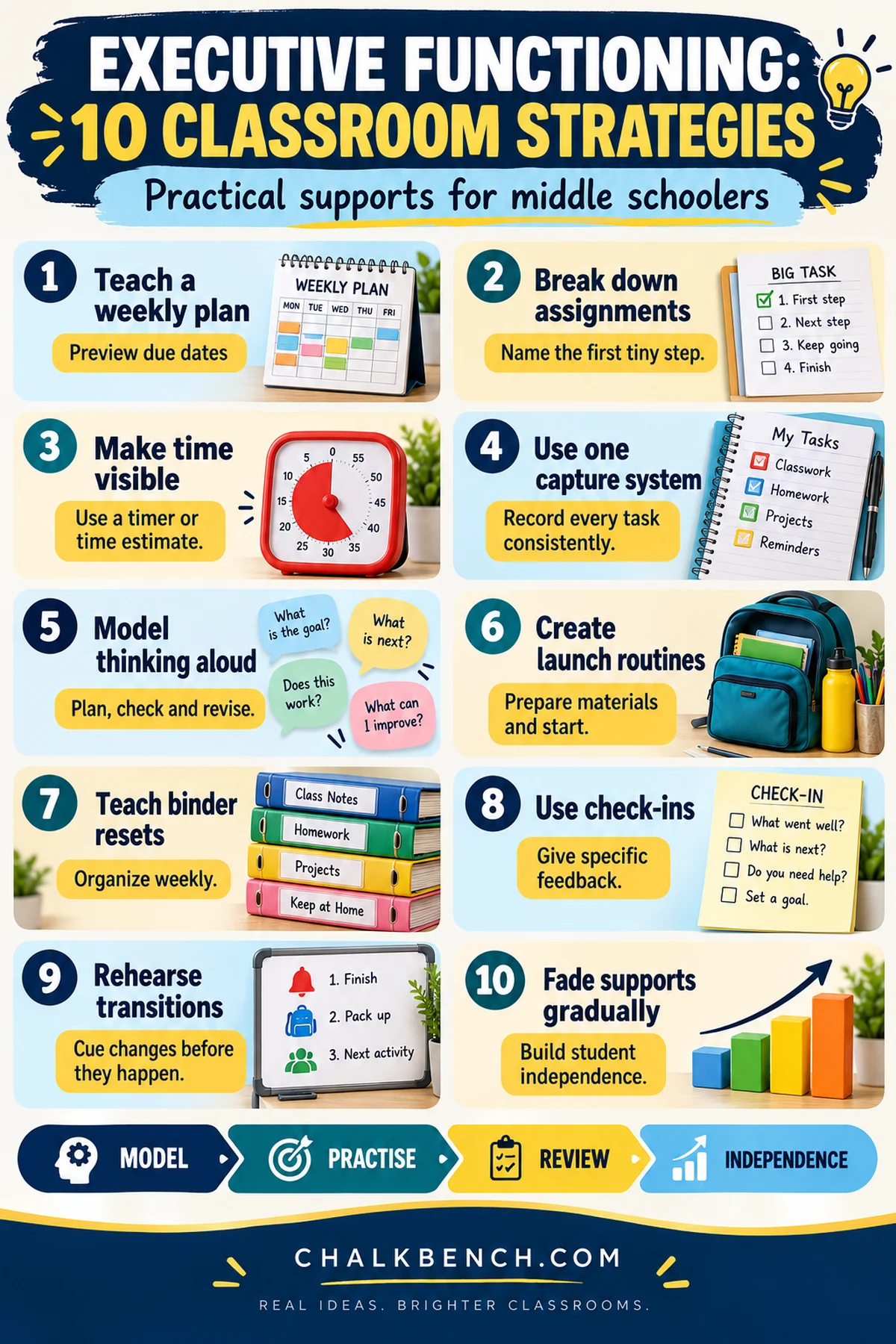
10 executive functioning strategies for middle schoolers
These executive functioning strategies can be used in general education, targeted intervention, tutoring, or supported study periods. Try one or two at first. Each strategy includes a practical teacher move and a sign to monitor.
1. Teach a weekly planning meeting—not just a planner
For weekly executive functioning strategies, reserve five minutes on Monday for students to look ahead: assignments, tests, activities, and potential bottlenecks. Project a simple weekly grid, demonstrate how to enter one deadline, and ask students to choose when they will start, not only when work is due. A Friday two-minute review identifies what was finished and what needs rescheduling.
Teacher script: “The report is due Thursday. What is one thing you can finish on Tuesday?” Check whether the student recorded a realistic start time and returned to the plan later that week.
2. Break assignments into first actions
Executive functioning strategies help expose the hidden decisions in “Complete the history presentation.” Make those steps visible: choose a question, locate two credible sources, write three key points, make three slides, and rehearse. Give the student a short checklist with a clear first action that can be finished within minutes. For longer projects, build checkpoints into the assignment rather than waiting until the deadline.
Students still work toward the same learning objective; the scaffold changes the process, not the academic expectation. Monitor whether they can initiate the first action with fewer prompts.
3. Make time visible and teach estimation
Executive functioning strategies for time management make an abstract demand more concrete, particularly when a task is unfamiliar. Before independent work, ask: “Will the first section take five, ten, or twenty minutes?” Record the estimate, use a simple visual timer where helpful, and compare the estimate with the actual time. Over several lessons, students can learn to adjust unrealistic plans.
Timers should help, not create panic. Offer a discreet countdown or time check for learners who find public countdowns stressful. Measure whether students begin earlier and finish a manageable step, not whether they always beat a clock.
4. Use one reliable assignment-capture system
Some students lose tasks between the teacher’s spoken instructions, the board, the learning platform, and a notebook. Agree on a single primary capture location: a planner page, school-approved app, or homework notebook. At the end of class, include a thirty-second routine: record the task, confirm the due date, and identify materials needed.
For students requiring more support, a teacher or peer can verify the entry briefly. Do not add three separate systems without a clear reason; duplication may increase the burden.
5. Model thinking aloud before independent work
Executive functioning strategies need modelling because students cannot automatically see the decisions made by an experienced learner. During a worked example, say: “First I identify the goal. Next I check the directions. I notice a missing detail, so I will ask a question. Finally I compare my answer with the criteria.” Invite students to repeat the process using a short cue card: Plan → Do → Check → Adjust.
Use the subject content already being taught—for instance, planning a persuasive paragraph or checking a fraction solution. The goal is transfer of a thinking routine, not a disconnected “brain-training” activity.
6. Build a two-minute task-launch routine
Executive functioning strategies for task initiation address a common barrier: beginning work can be harder than sustaining it. Establish a repeatable launch: take out materials, open the correct page, underline the instruction verb, and complete the first item. Initially, guide the whole class through these steps; later, use only a visual cue. If a learner stalls, point to the next concrete action rather than repeating “focus.”
Try a low-pressure check-in after two minutes. Record whether the student started with no prompt, one cue, or direct adult help.
7. Rehearse a weekly binder or digital-folder reset
Executive functioning strategies for organization work best when the desired end state is clear. On Fridays, students sort loose papers into two or three labeled sections, discard duplicates with permission, and check that upcoming-task materials are accessible. For a digital classroom, teach a consistent file-naming and folder routine rather than assuming students understand it.
Take a baseline of missing materials, then check whether the student can find the needed document within a reasonable time. Avoid turning the reset into public criticism of a messy bag.
8. Give brief, private check-ins and feedback
Replace broad judgments such as “You need to be more responsible” with a specific observation: “You recorded all three assignments today; next, let’s add start dates.” A private one-minute check-in can ask what worked, what remains difficult, and what support should change. This provides feedback without making the student’s needs a classroom spectacle.
Use a student-owned target, such as bringing required materials to four of five lessons, and celebrate progress without promising rewards that cannot be maintained.
9. Rehearse transitions before they happen
Executive functioning strategies for transitions address attention shifting, material management, and a new set of directions. Provide a brief advance cue, show a visual “finish–pack–start” sequence, and model what the completed transition looks like. Practise during calm periods, not only when an activity goes wrong.
For a student moving between classrooms, a packing checklist near the door or inside a folder can reduce repeated forgotten items. Watch whether transitions become smoother and less dependent on adult reminders.
10. Fade supports gradually instead of removing them suddenly
A successful checklist is not evidence that the student no longer needs it. First model the process, then complete it together, next ask the student to use the checklist while you observe, and finally check results at wider intervals. Some learners will continue to need an external aid; independence can mean choosing and using a support effectively, not memorizing everything.
Review executive functioning strategies with the student. If the task changes or stress increases, it may be appropriate to restore more support temporarily.
Executive functioning strategies in action: a research project
Suppose a Year 8 or Grade 7 student has a three-week geography project and repeatedly misses the first checkpoint. Instead of merely reminding them of the final deadline, the teacher demonstrates a five-minute planning conversation. The student writes the question, chooses one reliable source, creates a document, and records the next work session. Each checkpoint has an observable output: a question, two source notes, a paragraph plan, and a draft.
At the next lesson, the teacher asks which step was completed and what blocked the next one. The student chooses a new action and uses a small checklist independently. These executive functioning strategies preserve the learning goal while reducing the load of an unclear multi-stage assignment.
A four-week plan for executive functioning strategies
This is an illustrative teaching cycle, not a researched minimum period or legal requirement. Adjust it to the learner, school timetable, and existing individual support plan.
| Week | Teacher action | Student practice | Check |
|---|---|---|---|
| 1 | Identify one difficulty and model a routine. | Use a task-launch checklist together. | How often did work begin with support? |
| 2 | Add a weekly plan and one capture location. | Record tasks and first actions. | Are tasks and dates captured accurately? |
| 3 | Reduce prompts where success is stable. | Use the tools with a discreet check-in. | Can the student start with fewer cues? |
| 4 | Review together and adjust the system. | Explain which supports help and why. | What should stay, change, or return? |
Review executive functioning strategies: is the support helping?
To review executive functioning strategies, choose one or two observable indicators: assignments recorded correctly, materials ready, time to start, checkpoints met, or tasks submitted. Compare patterns over multiple lessons rather than interpreting one good day as permanent improvement. Ask the student whether the support feels usable and respectful.
A quick log might use three columns—Task recorded?, Started with how many prompts?, and Next action identified? Review the information every week or two, and adjust one variable at a time. Better organization is valuable even if grades do not immediately change. Avoid collecting personal information in unapproved apps or displaying individual data publicly.
If you adapt task formats or create practice options, preserve the actual learning goal. For more on checking adaptations, see ChalkBench’s guide to AI tools for differentiated instruction.
When classroom routines are not enough: US and England support
United States: A student whose disability substantially limits a major life activity may qualify for support under Section 504; some students also meet IDEA eligibility for an Individualized Education Program (IEP). A diagnosis does not, by itself, determine eligibility. Our IEP vs. 504 plan guide explains the two US support routes. If barriers persist, share documented concerns with the family and the school’s evaluation or student-support team. The U.S. Department of Education provides ADHD and Section 504 resources.
England: Schools should consider appropriate SEND support and reasonable adjustments where applicable, working with the special educational needs coordinator (SENCO) and family. Not every learner needs an EHCP, and support should not wait solely for a diagnosis. Our EHCP assessment guide explains the separate England process. Refer to the current SEND Code of Practice and local school procedures. The legal frameworks differ: do not transfer US IEP or 504 terminology directly into English school plans.
These classroom ideas are educational suggestions, not clinical treatment, a diagnostic checklist, or a substitute for an agreed student-support plan.
Executive functioning strategies: frequently asked questions
What are executive functioning skills in middle school?
They include planning, task initiation, working memory, attention control, organization, flexible thinking, and self-monitoring. Different students may find different parts difficult, especially as homework and subject transitions become more complex.
Are executive functioning difficulties the same as ADHD?
No. ADHD can involve executive functioning challenges, but the two terms are not interchangeable. Similar difficulties may also occur without ADHD and can be affected by stress, learning needs, or classroom conditions.
What is the best executive functioning strategy for a student who will not start work?
Try an explicit task-launch routine with a very small first step, a modeled example, and a brief check-in. Ask what is preventing the start; difficulty may reflect uncertainty, overload, or an inaccessible task rather than unwillingness.
Should middle schoolers use paper planners or digital apps?
Use whichever accessible, school-approved system the student can operate reliably. Teach the routine for entering, reviewing, and acting on tasks. Switching between multiple systems often makes the work harder.
How long does it take to improve organization skills?
There is no universal timetable. Skills need modeling, repetition, and feedback, and demands change across subjects and school years. Set a short review point, monitor a meaningful behavior, and adjust the support rather than promising a quick transformation.
Do executive functioning strategies replace an IEP, 504 Plan, or SEND support?
No. Executive functioning strategies can complement formal supports, but they do not cancel legal obligations, assessments, accommodations, or services that a learner needs. Follow the student’s existing plan and work with the relevant team.
How can parents reinforce the same routines at home?
To reinforce executive functioning strategies at home, agree on one shared assignment-recording method, review upcoming deadlines briefly, and praise effective use of a strategy instead of demanding perfect independence. Ask the student which reminder is useful and coordinate with teachers to avoid contradictory systems.
Sources and further reading
- Education Endowment Foundation (2025): Metacognition and Self-Regulated Learning, second edition.
- CDC (2026): ADHD in the Classroom.
- Langberg and colleagues (2012): Randomized evaluation of HOPS in middle school.
- Langberg and colleagues (2018): Randomized trial of homework and organizational interventions.
- Harvard Center on the Developing Child: Executive Function.
- Department for Education: SEND Code of Practice (England).
Editorial note: Research cited above concerns populations and outcomes described in each study; individual classroom tips are practical applications, not separately validated interventions. Last editorial review: 21 October 2026.