
US & England • Parent Rights Guide
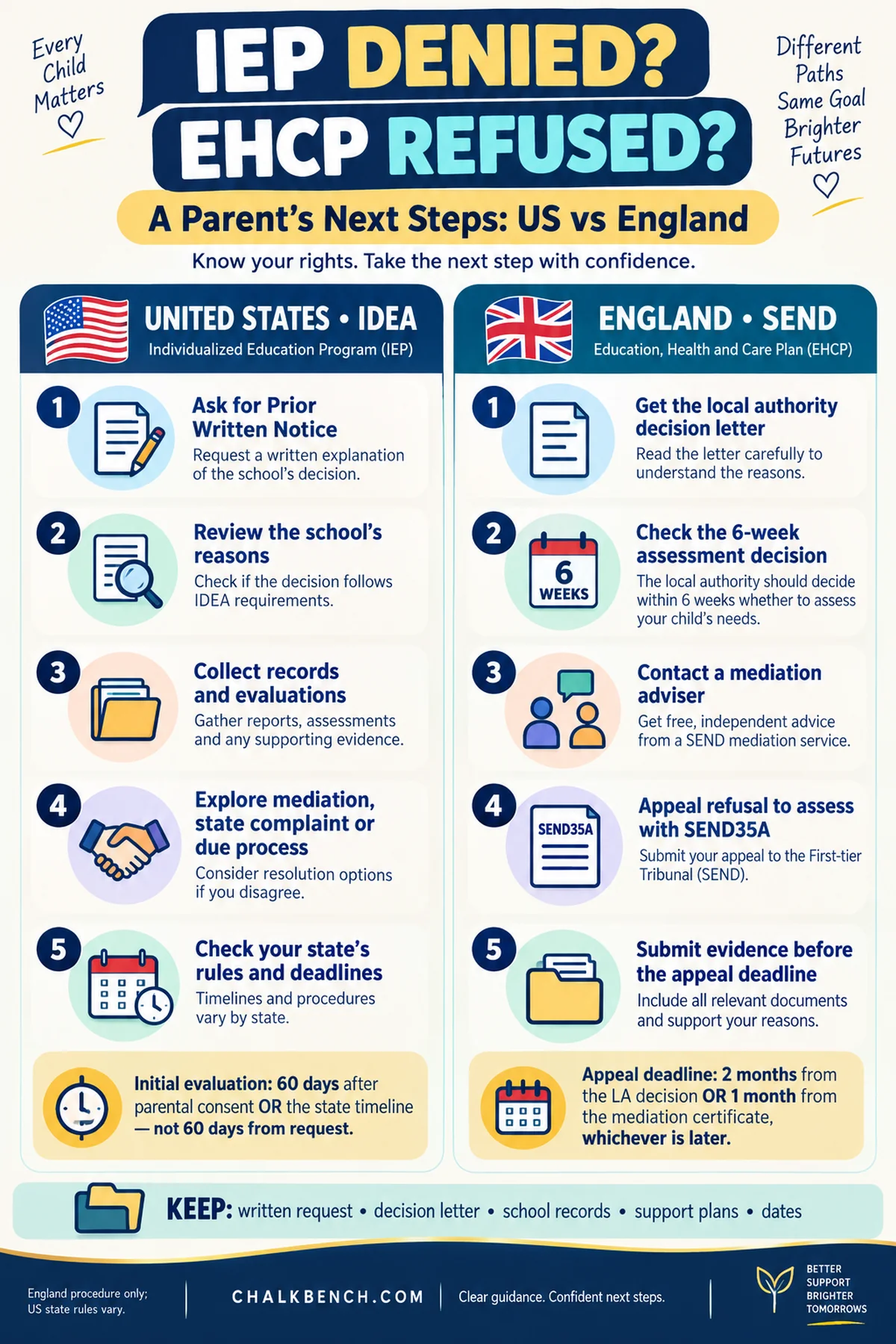
Quick answer: After an IEP denial in the United States, ask exactly what was denied, request the district’s Prior Written Notice where IDEA requires it, review the evidence, and consider your state’s dispute-resolution options. After an EHCP refusal involving your child’s EHC needs assessment in England, obtain the local authority’s decision letter, check the statutory deadline and mediation information, and consider appealing to the Special Educational Needs and Disability (SEND) Tribunal. A refusal is not necessarily the final decision, but the next step depends on which request was denied and where your child is educated.
Hearing “your child doesn’t qualify” can be upsetting, especially after months of meetings, school avoidance, unfinished work, or repeated requests for support. This guide provides practical steps, comparison tables, evidence checklists, example emails and appeal guidance for families navigating IEP denial in the US or EHCP refusal in England. It also explains mistakes to avoid, because the two systems are legally different even when families face similar obstacles.
Scope and important note: IEPs are governed by the US Individuals with Disabilities Education Act (IDEA) and applicable state rules. EHC plans, commonly called EHCPs, follow England’s Children and Families Act 2014 and SEND framework. The EHC system described here does not apply unchanged to Wales, Scotland or Northern Ireland. This article is general educational information, not legal representation or advice about an individual case. If you have received a refusal letter, check its date and seek local support promptly.
In this guide
IEP denial or EHCP refusal: identify the decision first
The phrase “IEP or EHCP request denied” often combines several decisions that require different responses. Before challenging an IEP denial or EHCP refusal, put the decision into one of these categories:
- Refusal to evaluate or assess: The authority has not agreed to investigate whether your child needs specialist provision. In the US this may be a district’s refusal to conduct an initial IDEA evaluation; in England it is commonly a local authority’s refusal to secure an EHC needs assessment.
- Assessment completed, but no plan: The team has evaluated your child and decided that the legal test for IDEA eligibility or an EHC plan is not met. The report, reasons and avenues of challenge differ from a refusal even to assess.
- A plan exists, but requested support was refused: A school or local authority may disagree about therapy, teaching hours, goals, placement, assistive technology or another provision. That is not necessarily a refusal of the whole plan.
- The school says it cannot help or submit the request: In England, a parent can request an EHC needs assessment directly from the local authority. In the US, a parent can request an initial IDEA evaluation rather than waiting for a teacher to make the referral.
For an IEP denial or EHCP refusal, ask for the specific decision in writing. Write down who made it, when it was made, what was considered, and what route is available to challenge it. A conversation with a teacher or SENCO is useful but does not replace the formal notice or decision you may need for a challenge.
IEP denial vs EHCP refusal: the key differences at a glance
| Question | United States: IDEA/IEP | England: SEND/EHCP |
|---|---|---|
| Who makes the formal decision? | The responsible public agency or school district; eligible IEP decisions involve a team including parents. | The local authority (LA), not simply an individual school, decides whether to assess or issue an EHC plan. |
| What should a refusal include? | Prior Written Notice, when required, with the action refused, reasons, evidence and safeguards. | A written LA decision explaining refusal and notifying families of appeal and mediation rights. |
| Initial assessment decision clock | No single federal 60-day clock from the initial request to the district’s response; state rules apply. | Normally within six weeks of the LA receiving the request to decide whether to assess. |
| Evaluation completion | Generally within 60 days after parental consent or within the state’s established timeframe, subject to exceptions. | After assessment, notification of a decision not to issue a plan normally must be given within 16 weeks of the original request. If a plan is required, the final plan normally must be issued within 20 weeks, subject to legal exceptions. |
| Disagreement pathways | IEP meeting and informal resolution; voluntary mediation; state complaint for alleged IDEA violations; due process complaint. Routes depend on the issue. | Mediation advice and potentially mediation, followed by appeal to the SEND Tribunal where an appealable LA decision exists. |
| Important caution | An independent educational evaluation at public expense has conditions; it is not automatic after any refusal. | Refusal-to-assess appeals use SEND35A; different EHC-plan appeals may use SEND35. |
The comparison is based on the official IDEA Prior Written Notice regulation, IDEA initial-evaluation rule, England’s SEND Regulations 2014, and GOV.UK’s SEND appeal guide.
United States: five practical steps after an IEP denial
Step 1. Put the request and refusal in writing
If an IEP denial followed an evaluation request made in person, send a dated email to your school’s special education director or designated district contact. Say that you are requesting an initial evaluation under IDEA, describe the suspected areas of need, and ask the district to respond under applicable federal and state procedures. A parent is permitted to initiate an initial evaluation request under 34 CFR §300.301(b). Do not assume that a teacher’s general comment that your child is “not severe enough” is the district’s formal legal response.
If the public agency refuses to initiate or change identification, evaluation, educational placement or provision of a free appropriate public education (FAPE), IDEA’s Prior Written Notice (PWN) rule requires notice containing the refusal, an explanation, the assessments or information relied upon, options considered and relevant safeguards. After an IEP denial, ask for this notice if you have been told “no” but received nothing in writing. You may also request a copy of your state’s procedural safeguards notice.
Useful wording: “Please provide the district’s Prior Written Notice explaining its refusal to evaluate my child under IDEA, including the information relied on and the procedural safeguards available to us.” Save the original email and the reply in a dated folder.
Step 2. Examine the evidence, not just the diagnosis
To understand an IEP denial, review IDEA eligibility’s two linked questions: does the student meet one of IDEA’s disability categories, and does the student need special education and related services because of that disability? A diagnosis may be relevant evidence, but it is neither automatically sufficient for an IEP nor always required before a school conducts an evaluation. The eligibility determination should draw on a variety of sources, including parent information and relevant functional or educational data, rather than one test or teacher impression.
For example, a child may pass academic tests yet struggle to begin assignments, participate in class, communicate needs, regulate behaviour or attend consistently. Conversely, needing general classroom adjustments does not by itself prove that specialised instruction under IDEA is legally required. Ask the team to explain which needs it considered, which information it discounted, and why. Under 34 CFR §300.306, parents are part of the eligibility determination group and must receive the evaluation report and eligibility documentation at no cost after evaluation.
Compare the IEP denial with concrete examples: work samples, progress-monitoring graphs, attendance and disciplinary patterns, documented communication difficulties, teacher notes, outside reports, interventions already attempted and your child’s own account. Identify what is missing. Do not send a huge unsorted file without a summary that connects evidence to the child’s educational access and needs.
Step 3. Understand the real evaluation timeline
A frequent misunderstanding is that a school must complete every IDEA evaluation within 60 days of a parent’s first email. The federal rule is more precise: an initial evaluation generally must be completed within 60 days after the school receives parental consent, unless the state has established a different timeline, and certain exceptions apply. The federal regulation does not establish a universal 60-day response clock beginning with the referral email; state provisions and the requirement to proceed in a reasonable period matter.
When reviewing an IEP denial or evaluation delay, keep four separate dates in your records: the date you requested an evaluation; the date the district responded; the date you provided informed evaluation consent (if applicable); and the date the evaluation or eligibility decision was communicated. This timeline helps a parent centre or advocate distinguish a delay from a substantive disagreement. The US Department of Education’s Child Find guidance explains that parents may challenge a refused initial evaluation, while the agency must respond through its procedural obligations.
Step 4. Select the dispute-resolution option that matches the problem
If the information behind an IEP denial appears incomplete, first request a meeting to review it and ask for a written explanation of the reasoning. A productive meeting can resolve some misunderstandings without a legal proceeding. However, an informal meeting is not a substitute for preserving formal filing deadlines.
- Voluntary IDEA mediation: Parents and the school district may use a neutral mediator to seek agreement. Federal rules require the process to be voluntary and prohibit using it to delay or deny a right to a due process hearing.
- State administrative complaint: This route addresses alleged failures to comply with IDEA requirements. Under federal rules the complained-of violation generally must have occurred not more than one year before receipt of the complaint. It may be appropriate, for example, when required written notice or procedural steps were not supplied.
- Due process complaint and hearing: This can address disputes about identification, evaluation, placement or FAPE. The general federal rule requires a hearing request within two years of when the parent or agency knew or should have known about the alleged action, unless the state has an explicit different time limit. Specified legal exceptions can apply, including certain misrepresentations or withheld information. A hearing is more formal, so expert legal or advocacy guidance can be valuable.
- Independent educational evaluation (IEE): If you disagree with an evaluation the public agency obtained, IDEA may entitle you to an IEE at public expense subject to the regulation. The agency must, without unnecessary delay, fund an eligible IEE or seek a hearing to defend its evaluation. A district’s refusal to perform any initial evaluation does not automatically trigger this same IEE right.
See the federal rules for mediation, state complaints, due process complaints, hearing-request time limits and exceptions, and independent educational evaluations. Procedures, hearing systems and extra protections vary by state, so use the state education agency’s safeguards document before filing.
Step 5. Keep suitable support moving while the dispute is considered
While an IEP denial is being reviewed, ask which supports the school can reasonably provide now and how progress will be tracked. Some children who do not qualify under IDEA may still be entitled to a disability evaluation or appropriate services under Section 504; the standards are different, and a “504 plan” is not simply a lesser IEP. Do not accept a blanket assertion that an IDEA refusal means the child has no disability-related educational rights at all. Our IEP vs. 504 plan guide explains the different US support routes.
When a family disputes an existing IEP’s services rather than initial eligibility, ask the team to document the changes being requested and why they were refused. Continue cooperating with appropriate, approved support for the child. If the situation involves a major change of placement, suspension, safety concern or urgent loss of access, seek state-specific advice immediately rather than relying only on generic email templates.
IEP denial email template: request Prior Written Notice (US)
Subject: Request for Prior Written Notice regarding IDEA evaluation decision — [Child’s name]
Dear [Special Education Director / School District Contact],
On [date], I requested an evaluation under the Individuals with Disabilities Education Act for my child, [name], who attends [school and grade]. I understand from [meeting/email/date] that the district is declining [the initial evaluation / the requested change to identification or services].
Please provide the Prior Written Notice required where applicable under 34 CFR §300.503. I would appreciate the specific action refused, the reasons for the decision, the evaluations or records used, any options considered and rejected, and a copy of or access to the relevant procedural safeguards. I would also welcome a meeting to review the educational and functional concerns described in my request.
My concerns include [two or three specific examples supported by dates, work samples or school observations]. Please confirm receipt of this message and the contact person for follow-up.
Thank you for your attention to [child’s name]’s educational needs.
Sincerely,
[Parent / guardian name]
[Contact details]
How to use it: For an IEP denial response, replace every placeholder and keep the message factual. Do not claim you received a formal refusal if you have only heard an informal opinion; instead, ask the district to clarify its position. If there is already a completed evaluation, adjust the letter to request the reports, eligibility documentation and explanation of the decision.
England: five steps after an EHCP refusal
Step 1. Check whether the decision is from the local authority
When checking an EHCP refusal in England, remember that a school SENCO can help prepare evidence or express a view, but the local authority decides whether to carry out an Education, Health and Care (EHC) needs assessment and whether an EHC plan is required. A school saying, “We won’t apply for an EHCP,” is not the same as a formal local authority refusal. Parents and eligible young people can make a request directly to the LA under section 36 of the Children and Families Act 2014.
When reviewing an EHCP refusal, keep proof of when the LA received the request—such as an email acknowledgement—and ask for a dated written decision. This date starts a statutory timeline. If the school has not supported the request, that alone does not prevent the family from asking the LA to assess. Our EHCP assessment request guide explains the initial England process.
Step 2. Apply the actual legal threshold for assessing
Section 36(8) says an LA must carry out an EHC needs assessment if the child or young person has or may have special educational needs and it may be necessary for special educational provision to be made in accordance with an EHC plan. For an EHCP refusal at this stage, the question is whether an assessment is needed—not whether the child has already proved that a final plan must be issued.
IPSEA explains why a rigid extra condition—such as requiring a formal diagnosis, a set number of terms on SEN Support, or a school to exhaust a particular funding band—is not the legal test by itself. Evidence of support tried, current barriers and lack of sufficient progress may strengthen an application, but the LA must apply the statutory test to the individual child. Read the independent guidance on asking for an EHC needs assessment and the legal threshold.
Step 3. Read the refusal letter and calculate the deadline immediately
The LA normally must notify families whether it will assess within six weeks of receiving the EHC needs assessment request. For an EHCP refusal to assess, the notification must explain the right to appeal and provide information on mediation and support services. Check the date at the top of the letter, not only the day you opened the email or received the envelope.
For an appealable EHCP refusal, the usual deadline is the later of two months from the date of the LA’s decision letter or one month from the date of the mediation certificate. These are alternative calculations and the later deadline applies; do not treat them as an automatic three-month extension. Seek advice promptly if the letter arrived late or a deadline is approaching. Check the official tribunal appeal guidance for the current submission route.
Step 4. Contact a mediation adviser and choose whether to mediate
In most EHC appeals, parents or young people must consider mediation and obtain advice from a mediation adviser before appealing. They do not have to agree to a mediation session in order to preserve the right to appeal: where mediation is declined, the adviser can issue the necessary certificate. A narrow exception applies to certain appeals only about a school or institution named in Section I of an EHC plan. That exception generally does not help someone appealing a refusal to assess.
Mediation contact details for an EHCP refusal should appear in the LA decision letter. If they do not, request them at once and use the GOV.UK mediation guide. Mediation may help the LA reconsider a dispute, but parents should not wait indefinitely for an informal meeting while an appeal deadline runs.
Step 5. Use the correct SEND Tribunal route and form
If the LA refused to conduct an EHC needs assessment, the government provides Form SEND35A and an associated online service for refusal-to-assess appeals. GOV.UK identifies SEND35 as a form for other appeal types. Do not accidentally use the form for challenging the content of an existing final EHC plan when there is no plan yet.
Your EHCP refusal appeal should explain, in plain language, why the assessment threshold is met and identify the evidence supporting each point. A useful outline is: (1) your child’s needs and concerns; (2) what the school has tried; (3) remaining difficulties or gaps; (4) why an assessment may be necessary to identify provision that should be secured through an EHC plan; and (5) the exact decision being appealed.
Successful challenges depend on the individual facts, not a universal success guarantee. If the LA has already assessed but refused to issue a plan, you are challenging a different decision; focus on why a plan is necessary and use the relevant guidance and appeal form. Families can seek free, impartial help from their local SEND Information, Advice and Support Service (SENDIASS) or specialist organisations such as IPSEA.
IEP denial and EHCP refusal: time limits to save
| Event | Time rule to check | What starts the clock? |
|---|---|---|
| US initial IDEA evaluation | 60 days or the state’s specified timeframe, subject to exceptions. | Parental consent for the evaluation—not the original request. |
| US IDEA state complaint | Typically concerns an alleged violation within the previous one year. | When the state receives the complaint and the time of the alleged violation. |
| US IDEA due process complaint | Generally request a hearing within two years; explicit state time limits and legal exceptions may apply. | When a party knew or should have known of the alleged action. |
| England LA decides whether to assess | Normally within 6 weeks. | When the LA receives the EHC needs assessment request. |
| England LA refuses to issue a plan after assessment | Normally decision within 16 weeks of the initial request. | When the original request was received. |
| England issues a final EHC plan where required | Normally within 20 weeks, with statutory exceptions. | When the original request was received. |
| England SEND Tribunal appeal | 2 months from decision letter OR 1 month from mediation certificate, whichever is later. | Dates on the official decision letter and certificate. |
Important: These rows are not interchangeable deadlines. In particular, the US 60-day evaluation period is not a deadline for the school to agree to an assessment, and England’s six-week decision is not the deadline for producing the entire EHCP. Also, a formal appeal deadline should not be inferred from informal negotiations.
EHCP refusal email template: challenge a refusal to assess (England)
Subject: Request for reasons and next steps — refusal of EHC needs assessment for [Child’s name]
Dear [Local Authority SEND Assessment Team],
I am writing about your decision dated [date] refusing to secure an Education, Health and Care needs assessment for [child’s name], who attends [school/setting]. I disagree with that decision and would like to understand how the statutory test under section 36(8) of the Children and Families Act 2014 was applied.
My child has or may have special educational needs in the following areas: [brief, factual description]. The available evidence suggests an EHC needs assessment may be necessary because [explain current support, its limits and the additional information or provision needed]. Attached are [list of reports, school records or parent evidence].
Please provide or confirm the written reasons for refusal, the mediation adviser’s contact details, appeal rights and applicable dates. I understand I may seek mediation advice and consider an appeal to the SEND Tribunal. I would also welcome clarification of any additional information you considered when reaching the decision.
Kind regards,
[Parent / carer name]
[Contact details]
Do not confuse this letter with filing an appeal. For an EHCP refusal, sending an email to the LA asking it to reconsider is not the same as lodging the correct Tribunal appeal on time. Keep proof of sending, contact the mediation adviser promptly and use the official form when required.
IEP denial or EHCP refusal: organise the evidence folder
Well-organised evidence for an IEP denial or EHCP refusal does more than show that a child has difficulties. It helps decision-makers understand how the difficulties affect learning, participation and the level of provision being requested. A clear index and short chronology are more useful than a large pile of unlabelled documents.
| Document | Why it matters | Practical note |
|---|---|---|
| Original request and acknowledgement | Shows what you asked and when it was received. | Keep email headers, letters and delivery receipts. |
| Refusal or formal decision letter | Explains the decision and may trigger an appeal deadline. | Preserve an unedited copy and note the document date. |
| Attendance, behaviour and support records | Shows patterns affecting educational access. | Add context; avoid assuming behaviour proves a diagnosis. |
| Assessments and professional reports | Documents identified needs and functional barriers. | Include dates, authors and the limitations of each report. |
| School interventions and progress data | Shows what was attempted, duration and response. | Distinguish informal promises from actual provision delivered. |
| Examples of classroom work | Demonstrates a specific need in context. | Annotate two or three representative samples instead of every page. |
| Child or young person’s views | Gives their first-hand account of barriers and what helps. | Use age-appropriate words or communication supports. |
| Parent chronology | Connects events, responses and follow-ups. | A one-page date / event / evidence table works well. |
Protect your child’s privacy. Use approved, secure channels when sharing reports; avoid entering identifiable medical or education records into public AI tools. Teachers looking for general ways to adapt learning materials while preserving learning goals can read ChalkBench’s guide to AI tools for differentiated instruction, which explicitly advises human review and privacy safeguards rather than replacing a support plan.
One-page chronology parents can copy
- [Date]: I requested [IDEA evaluation / EHC needs assessment]. Evidence: [email filename].
- [Date]: School or LA replied [brief description]. Evidence: [letter filename].
- [Date]: The child experienced [specific educational access issue]. Evidence: [school record].
- [Date]: We tried [intervention/support] and the result was [observable outcome]. Evidence: [report or meeting notes].
- [Date]: Next legal or administrative action due: [source-checked deadline].
IEP denial or EHCP refusal: questions for a review meeting
IEP denial and EHCP refusal meetings can feel adversarial, especially when families and staff have used different language to describe the same child. Keep your questions specific and ask for the reasoning behind decisions. Consider these prompts:
- “Can you confirm exactly which request you are refusing—the assessment, eligibility, the plan itself or one element of provision?”
- “Which evidence did you rely on, and were my observations and the child’s views considered?”
- “What legal threshold or policy was applied? May I have that explanation in writing?”
- “What support will continue now, who will provide it, and when will it be reviewed?”
- “What information would materially change the assessment or eligibility decision?”
- “What procedural safeguards, mediation or appeal routes are available, and where can I obtain the official guidance?”
- “Can we agree which documents and actions each person will share after this meeting?”
Stay factual, but do not feel obliged to agree with a decision simply to keep the conversation polite. Request a copy of the meeting record or send a short follow-up email with your understanding of what was decided. A respectful written record protects families and helps school staff resolve practical issues more quickly.
IEP denial and EHCP refusal: common statements to check
“Your child is making passing grades, so they cannot have an IEP.”
When questioning an IEP denial, remember that grades are one source of information, not the entire IDEA eligibility test. Ask whether the evaluation considered all relevant areas of suspected disability and educational need. A parent should not assume passing grades automatically establish eligibility either; the legal test still includes a need for special education and related services.
“We need to try every intervention before we can evaluate.”
Good classroom instruction and interventions can be important, but schools should not treat a generic intervention cycle as permission to postpone an appropriate IDEA evaluation when disability is suspected. Ask for the applicable state rules and written decision, and consult the district’s Child Find obligations.
“The child must have a medical diagnosis before the LA can assess.”
When checking an EHCP refusal to assess in England, the legal question is whether the child has or may have SEN and may need provision via an EHC plan. A diagnosis can provide useful evidence but is not a universal precondition written into that statutory test. Explain actual needs and barriers even if a diagnostic pathway is still in progress.
“We cannot ask for an EHCP until the school applies.”
Parents and eligible young people can request an EHC needs assessment directly from the local authority. Ask the school for evidence and support, but do not rely solely on an informal assurance that a future application will eventually be made.
“Requesting reconsideration stops your appeal clock.”
Do not assume it does. In England, informal discussions or a letter asking the LA to reconsider should not be treated as automatically suspending Tribunal deadlines. In the US, mediation is voluntary and cannot be used to deny or delay a due process right, but individual limitations periods and procedures still require attention.
IEP denial or EHCP refusal: a first-week response plan
This IEP denial and EHCP refusal response plan contains organisational suggestions rather than statutory daily requirements. They can help keep a difficult process manageable:
- Day 1 — Secure the decision: Save the written refusal, or ask for the official response if only a verbal statement exists.
- Day 2 — Confirm jurisdiction and refusal type: Note US state or England LA, then identify whether the issue is refusal to evaluate, failure to qualify or disagreement over provision.
- Day 3 — Set calendar reminders: Write down the correct source-verified deadline. In England include the decision-letter date and mediation certificate date; in the US review the relevant state safeguards.
- Day 4 — Organise evidence: Collect a small, labelled selection of relevant records and a one-page chronology.
- Day 5 — Get independent information: Contact a US Parent Training and Information Center or an England SENDIASS/IPSEA service.
- Days 6–7 — Choose and document the next action: Send a clear response, request any appropriate meeting, contact the mediation service or prepare the formal challenge that fits the decision.
A legal deadline may fall sooner than this organisational plan allows. If that is the case, put the deadline first. You do not need a perfect binder before asking an adviser whether urgent filing is required.
IEP denial and EHCP refusal: frequently asked questions
1. Can a school refuse to evaluate my child for an IEP in the United States?
A school district may decide that a particular initial IDEA evaluation is not warranted, but it must follow IDEA’s applicable obligations, including Prior Written Notice when it refuses to initiate an evaluation. A parent may challenge an IEP denial through the procedures available under state and federal rules.
2. Does a medical diagnosis automatically qualify my child for an IEP?
No. IDEA eligibility is based on statutory disability criteria and a need for special education and related services, as determined through the applicable evaluation and eligibility process. When reviewing an IEP denial, medical and specialist reports can be valuable evidence but are not a substitute for the complete legal determination.
3. What if my child has ADHD or dyslexia but the school says grades are fine?
After an IEP denial, ask the team to examine the full educational and functional picture, including attention, communication, participation, work completion and documented supports. Grades alone should not be treated as the entire analysis. Depending on the child’s needs, an IDEA evaluation or Section 504 consideration may be appropriate.
4. Is there always a 60-day deadline after I email a US school?
No. IDEA’s general 60-day initial-evaluation rule starts with parental consent for the evaluation unless a state-established timeframe applies, with specified exceptions. The period from a parent’s original request to the agency’s response is a distinct issue and may be addressed by state procedures and federal reasonableness obligations.
5. Can I ask for a second independent evaluation at the district’s expense?
An IEE at public expense may be available when a parent disagrees with an evaluation obtained by the public agency, subject to 34 CFR §300.502. It is not an automatic right to a publicly funded private evaluation after any refusal. For an IEP denial dispute, ask a state parent centre to explain the distinction.
6. Can a parent request an EHC needs assessment without the school’s agreement?
Yes. In England, section 36 of the Children and Families Act 2014 permits a parent or eligible young person to make the request directly to the local authority. It is sensible to ask the school for supporting information, but school endorsement is not a legal prerequisite to submitting a request.
7. How long does an English local authority have to refuse or agree to assess?
The LA normally must notify the parent or young person of its assessment decision within six weeks of receiving the EHC needs assessment request. Other later stages have distinct 16-week and 20-week deadlines, with legally specified exceptions.
8. Must I attend mediation before appealing an EHCP refusal?
For most appeal types, including refusal to assess, you must contact a mediation adviser and obtain the relevant certificate, but you do not have to take part in a mediation meeting. There are limited exceptions for certain school-placement-only appeals. Check the refusal letter and government guidance for your appeal type.
9. Which form should I use if England’s local authority refuses to assess?
For an EHCP refusal to assess, the government identifies SEND35A for appealing a refusal to secure an EHC needs assessment. For other disputes, including many appeals about an existing plan, a different form such as SEND35 may apply. Use the current official government page rather than relying on an old download.
10. Does asking the LA to reconsider extend my appeal deadline?
After an EHCP refusal, do not assume that informal reconsideration extends the deadline. The normal appeal period is the later of two months from the LA decision letter or one month from the mediation certificate. Contact an independent adviser promptly if you are approaching either date.
11. What should parents do while waiting for a decision or appeal?
Ask the school what educational support is available now, how it will be documented and when its effectiveness will be reviewed. Keep attending appropriate meetings, record the child’s experiences and seek timely help if there is significant distress, exclusion or loss of educational access. A pending dispute does not make a child’s current needs disappear. For classroom ideas to discuss with staff, see our ADHD accommodations guide. Match any adjustment to the child’s actual needs and existing support arrangements.
Official IEP denial and EHCP refusal sources
Use primary sources for law, deadlines and forms. For an individual appeal, check the latest local guidance and the refusal letter in addition to this overview:
- US: IDEA — Prior Written Notice (§300.503); Initial Evaluations (§300.301); Eligibility (§300.306); IEE (§300.502).
- US dispute options: Mediation (§300.506); State Complaints (§300.153); Due Process (§300.507); Hearing Time Limits (§300.511); IDEA family resources.
- England: Children and Families Act 2014, section 36; SEND Regulations 2014; SEND Code of Practice.
- England appeals: GOV.UK Tribunal guide; official SEND35A guidance; IPSEA practical guidance.
Editorial note (reviewed 14 October 2026): England’s SEND reform consultations announced in 2026 are proposals rather than substitutes for the cited statutory rules unless and until implemented. Always verify law and tribunal procedures that apply on the date of your child’s decision.
After an IEP denial or EHCP refusal, get the right written decision, match your evidence to the correct legal test, protect the relevant deadline and use independent support early. Parents do not have to solve every legal question alone—but careful records and clear requests make the next step much easier.