
SPECIAL EDUCATION · US TEACHER GUIDE
Quick answer: Measurable SMART IEP goals begin with the student’s documented present level, identify a teachable academic or functional skill, set an observable target, and name how and when progress will be checked. A strong goal can be understood by a parent, taught by a specialist, and scored consistently by another educator. Below you will find a writing formula, eight adaptable examples, a monitoring plan, and a copy-and-paste template.
Writing SMART IEP goals is not about filling an IEP with impressive numbers. It is about planning meaningful instruction and checking progress for a particular student. The examples here are invented teaching illustrations, not goals to copy unchanged into a real child’s plan.
In this guide
SMART IEP Goals: What Does IDEA Actually Require?
Under the US Individuals with Disabilities Education Act (IDEA), an Individualized Education Program must describe the student’s present levels of academic achievement and functional performance (often shortened to PLAAFP) and include measurable annual goals addressing disability-related educational needs. The IEP must also explain how progress will be measured and when periodic progress reports will be provided to parents. See 34 CFR § 300.320.
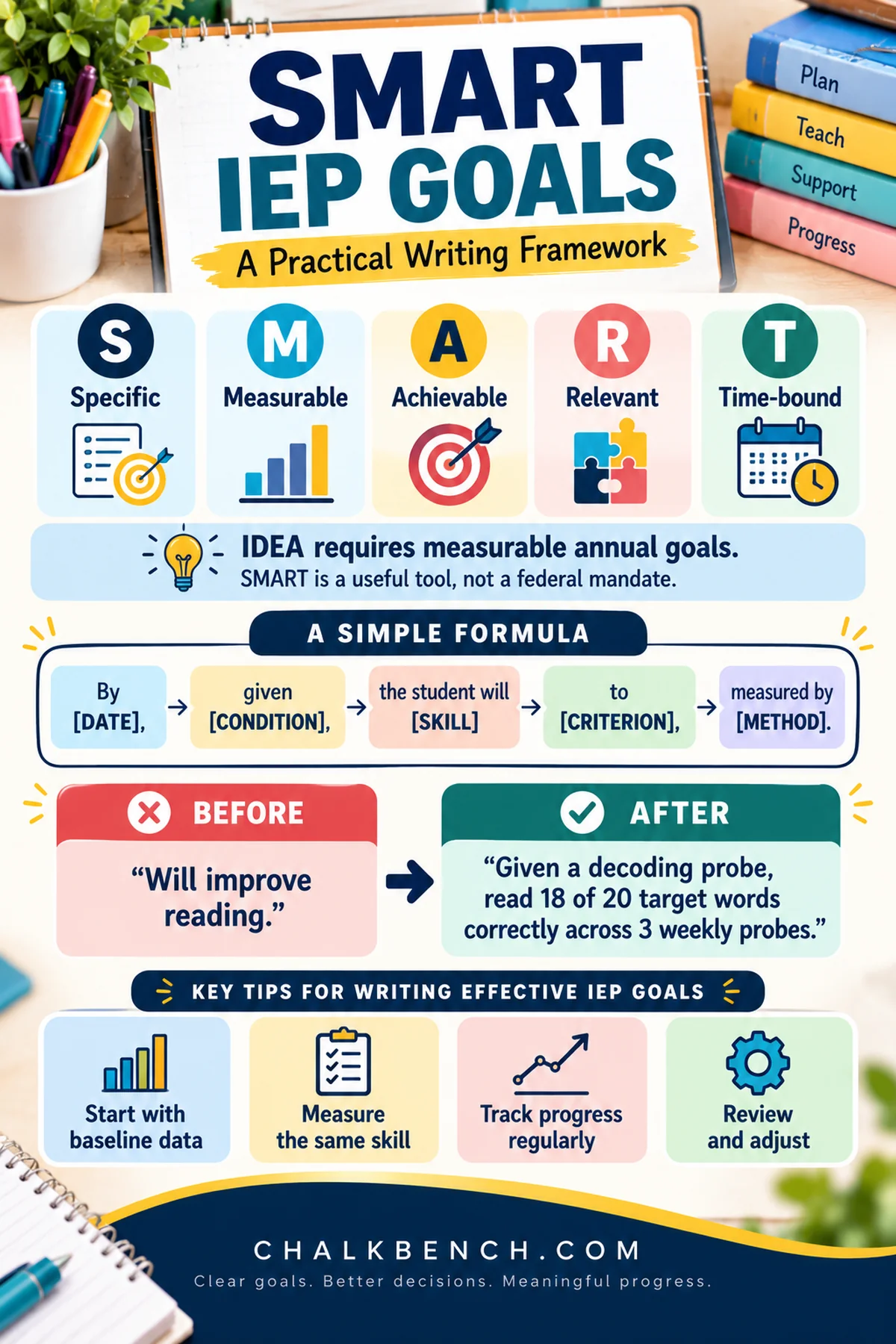
IDEA does not require educators to use the acronym SMART or one universal goal sentence. SMART is a helpful planning framework. It does not replace the legal requirements, the student’s evaluation information, the IEP team’s judgment, or any additional state rules. Federal law also requires benchmarks or short-term objectives for students taking alternate assessments aligned to alternate academic achievement standards; they are not a blanket federal requirement for every IEP.
Goals must connect to the child’s actual needs and the instruction and services in the IEP—not just mirror an online goal bank. The team includes parents and relevant educators, and their input matters when defining priorities and realistic expectations. For broader eligibility context, read ChalkBench’s IEP vs. 504 Plan parent guide.
The SMART IEP Goals Framework, Explained
A useful teacher-friendly version of SMART is Specific, Measurable, Achievable, Relevant, and Time-bound. Different training resources use alternative words such as “actively phrased” or “realistic.” The Vanderbilt IRIS Center emphasizes four practical goal elements: target behavior, condition, performance criterion, and timeframe.
| SMART element | Teacher question | What to write |
|---|---|---|
| S — Specific | What will the learner actually do? | Name an observable skill such as decoding, solving, initiating, requesting, or writing. |
| M — Measurable | How will we see growth? | Specify a score, count, frequency, duration, accuracy, or clearly defined rubric. |
| A — Achievable | Is the target ambitious yet plausible? | Use baseline data, instructional time, prior growth, and available supports. |
| R — Relevant | Does the skill address a documented need? | Link it to PLAAFP and access to learning or other educational needs. |
| T — Time-bound | When will mastery be checked? | Use an annual review date or another appropriate, explicit deadline. |
A goal can be measurable without relying on “80% accuracy.” For some students, useful measures include words correct per minute, frequency of independent help requests, number of completed task steps, or rubric-defined communication quality. The important test is whether two trained adults could collect comparable evidence.
A Copy-and-Paste Formula for SMART IEP Goals
By [annual review date], when given [task, setting, materials, and agreed supports], [student] will [observable skill] to [performance criterion] across [number of opportunities or probes], as measured by [named tool and collection schedule].
Example: By the next annual review, given a 20-word probe of unfamiliar words containing previously taught two-syllable patterns, the student will decode at least 16 words correctly on three consecutive weekly probes, as measured by teacher-scored decoding records.
The associated PLAAFP might show a baseline of 7 of 20 words correct on comparable probes. That baseline is essential: a target without a starting point makes progress difficult to judge. The criterion and deadline in this illustration are not universal standards or recommended targets for every student.
How to Write SMART IEP Goals in Five Steps
1. Start with a precise present-level statement
To draft SMART IEP goals, choose assessment evidence that matches the skill to be taught: classroom work, curriculum-based probes, observations, or relevant specialist measures. Document what the student can do with specified supports and what remains difficult. Instead of “struggles with writing,” record “independently includes a claim and one relevant reason in 1 of 5 writing samples.” Check that evaluation information is sufficiently broad; IDEA calls for multiple assessment tools and sources, not a single score in isolation (34 CFR § 300.304).
2. Select one meaningful target skill
Prioritize SMART IEP goals that improve participation, independence, communication, or access to the curriculum. Avoid combining decoding, fluency, comprehension, and behavior into one unscorable sentence. A larger educational priority can contain multiple distinct annual goals where appropriate. Respect strengths and accommodations; a student may demonstrate mastery through speech, typing, signing, or an AAC device when that is appropriate to the skill being assessed.
3. Define the conditions and prompts
In SMART IEP goals, include the task type, setting, permitted tools, and prompt level where those details affect interpretation. “Independently” should not mean withdrawing disability-related supports the student needs. If a visual checklist is part of the plan, say so. If the skill is using a help-request strategy, count successful communication rather than eye contact or conformity to one adult-preferred format.
4. Set an ambitious, justified criterion
Set targets for SMART IEP goals that represent meaningful growth from baseline. For example, a student consistently solving 3 of 10 comparable problems might have an appropriately challenging aim of 8 of 10, but only after the team considers instruction, task complexity, growth history, and the student’s circumstances. Neither 80% nor “four out of five trials” is a federal rule. State how many observations are needed to show consistent performance.
5. Decide who collects data and how often
Monitor SMART IEP goals with a method that captures the exact behavior: a brief probe, rubric, work sample, event tally, or timed observation. Specify its frequency and how results will inform teaching. The goal is not complete if the team has no practical way to track it during an ordinary school week. The IEP itself must describe the progress-measurement method and timing of parent reports.
Eight SMART IEP Goal Examples Teachers Can Adapt
These illustrative SMART IEP goals cover academic and functional skills. Each assumes a matching individualized PLAAFP statement. Numbers are sample values only; an actual IEP team must determine suitable baselines, objectives, services, accommodations, and targets.
1. Phonics and decoding
Baseline: 7/20 unfamiliar two-syllable words containing previously taught patterns decoded correctly. Goal: By the annual review, given a 20-item comparable decoding probe, the student will decode at least 16 words accurately across three consecutive weekly probes. Measure: teacher-scored word lists with consistent pattern difficulty.
2. Oral reading fluency
Baseline: median of 54 words correct per minute on three equivalent instructional-level passages. Goal: By the annual review, given equivalent passages and appropriate access supports, the student will read at least 78 correct words per minute on three consecutive weekly probes. Measure: one-minute oral-reading records. Choose passage level and a target appropriate to the student; speed should not come at the expense of comprehension or accuracy.
3. Reading comprehension
Baseline: answers 2/5 literal and inferential questions correctly after a comparable passage. Goal: By the annual review, after reading or accessing a comparable instructional-level informational text, the student will answer at least 4/5 targeted questions on three of four probes given every two weeks. Measure: a consistent five-item question protocol with an answer key.
4. Written expression
Baseline: meets one of four agreed paragraph criteria on typical writing prompts. Goal: By the annual review, given a grade-relevant prompt and the specified planning organizer, the student will produce a paragraph meeting at least three of four rubric criteria across three consecutive writing samples. Measure: a four-point analytic rubric defining topic sentence, supporting detail, organization, and closing statement.
5. Mathematics word problems
Baseline: solves 3/10 comparable two-step problems accurately. Goal: By the annual review, using approved representations or manipulatives, the student will solve at least 8/10 two-step word problems correctly on three of four probes given every two weeks. Measure: scored ten-item assessments with aligned difficulty.
6. Task initiation and organization
Baseline: starts a familiar independent task within five minutes in 2/5 observed opportunities using the existing visual checklist. Goal: By the annual review, given a clear task direction and the same visual checklist, the student will begin within five minutes in at least 4/5 opportunities for four consecutive weeks. Measure: brief start-time observation tally.
7. Self-advocacy and communication
Baseline: communicates a need for clarification or assistance in 1/5 naturally occurring, documented opportunities. Goal: By the annual review, using the student’s preferred communication method, the student will request clarification or help in 4/5 opportunities over three consecutive weeks. Measure: defined opportunity-and-response tallies that record a request when it clearly communicates a need for help. Never make access to help contingent on completing a target behavior.
8. Following transition routines
Baseline: completes a planned classroom transition using a visual schedule and agreed sensory supports in 2/5 observed transitions. Goal: By the annual review, given advance notice, the visual schedule, and the same supports, the student will complete the agreed transition sequence in 4/5 opportunities for three consecutive weeks. Measure: a short step-completion checklist. The goal is access and predictability, not forcing a child to suppress distress.
How to Monitor SMART IEP Goals Without Endless Paperwork
For SMART IEP goals, match the frequency of data collection to the skill. Quick weekly academic probes may make sense for decoding; an opportunity-based tally might better capture communication or independence. The IRIS Center’s monitoring guidance recommends objective data that can be analyzed and used to make instructional decisions.
| Record | Example | Why it matters |
|---|---|---|
| Baseline | 7/20 words | Defines the starting point. |
| Probe 1 | 9/20 words | Shows an early data point. |
| Probe 2 | 11/20 words | Allows trend comparison. |
| Probe 3 | 10/20 words | Prompts a look at instruction and variability. |
| Annual target | 16/20 across three consecutive weekly probes | Defines the agreed mastery criterion. |
This is fictional demonstration data, not evidence of an intervention’s effectiveness. Chart results using equivalent measures; note changes in attendance, accommodations, materials, or teaching that could affect scores. Share progress with parents on the schedule written in the IEP, and seek team review when data show a lack of expected progress rather than waiting automatically for the next annual meeting. IDEA requires review at least annually and appropriate revision when progress is insufficient (34 CFR § 300.324).
SMART IEP Goals: A Teacher Planning Template
Copy these fields into your planning notes. Replace every bracketed item with the team’s individual decisions before using the draft in a student’s IEP.
- Present level and baseline: [dated evidence, task difficulty, supports and current score].
- Annual goal: By [date], given [conditions and agreed supports], [student] will [observable skill] to [criterion] across [number of opportunities or probes], measured by [method and schedule].
- Monitoring responsibility: [trained staff member], collecting data [when and where].
- Parent reporting: [specific schedule recorded in the IEP].
- Review: [how the team will examine the trend and respond to insufficient progress].
Five Common Mistakes in SMART IEP Goals
- Vague verbs: “improve,” “understand,” and “try harder” do not identify an observable performance. Describe what will be read, written, solved, communicated, or completed.
- No baseline: without present-level data, the team cannot justify why a target is suitably challenging.
- Arbitrary percentages: using “80% in four out of five trials” for every skill ignores the nature of different learning outcomes.
- Missing conditions: results change when material difficulty, prompts, assistive technology, or settings differ. Specify the important conditions.
- Collecting data but not acting: the purpose of monitoring is to adjust instruction and supports, not merely complete a reporting box.
SMART IEP Goals: A Quick Quality Checklist
- Does the goal flow from the student’s documented present levels and educational needs?
- Could two educators identify the same target behavior and score it consistently?
- Are conditions, approved supports, mastery criterion, and annual timeframe clear?
- Is the target ambitious and individualized rather than copied from a generic bank?
- Is the data-collection method realistic, with scheduled reports to parents?
- Does the team know when and how to reconsider instruction if progress stalls?
Frequently Asked Questions About SMART IEP Goals
Are SMART IEP goals required by federal law?
IDEA requires measurable annual goals, not the acronym SMART. Educators use SMART as a drafting aid to check whether a goal is understandable, measurable, relevant, and time-limited.
How many IEP goals should a student have?
Federal IDEA rules do not set one number for every student. The team determines the goals needed to address the child’s disability-related academic and functional educational needs, avoiding both unnecessary duplication and important gaps.
Must every goal include 80% accuracy?
No. Use a criterion that suits the skill and documented baseline. Frequency, duration, rubric scores, work samples, and words correct per minute may be more meaningful than one percentage.
Are short-term objectives always required?
Under the federal rule, benchmarks or short-term objectives are specifically required for students taking alternate assessments aligned to alternate academic achievement standards. State or local rules may add requirements, and teams may use interim steps when helpful.
Can an IEP include social, communication, or organization goals?
Yes, when they address disability-related educational needs. IDEA covers measurable academic and functional goals; educational relevance and individualized evidence are central to the decision.
How often should parents receive IEP progress reports?
The IEP must state when periodic reports will be issued; federal law does not impose one universal quarterly frequency. A team may align reports with grading periods if appropriate and record that schedule in the IEP.
What should teachers do when an annual goal is not on track?
Review SMART IEP goals alongside the data, teaching, implementation, task difficulty, and supports with the team. The IEP may need revision when the child is not making expected progress. Do not wait for an arbitrary deadline to raise concerns.
SMART IEP Goals That Lead to Better Teaching
A useful SMART IEP goal is short enough to understand yet specific enough to guide instruction. Start with the learner’s evidence, select a meaningful skill, document how performance will be measured, and review actual growth. Strong IEP writing should help educators and families make better decisions—not simply generate better-looking paperwork.
Sources and Further Reading
- U.S. Department of Education — IDEA, 34 CFR § 300.320: IEP contents.
- U.S. Department of Education — IDEA, 34 CFR § 300.324: IEP development and review.
- U.S. Department of Education — IDEA, 34 CFR § 300.304: Evaluation procedures.
- Vanderbilt IRIS Center — Challenging, ambitious, measurable annual goals.
- Vanderbilt IRIS Center — Monitoring and reporting progress.
- Center for Parent Information and Resources — Annual goals in the IEP.
Editorial note: This guide discusses US federal IDEA requirements for public-school special education. It is general educational information, not legal advice or an individualized IEP recommendation. Check your state education agency and district procedures before finalizing any student plan. Source review: October 2026. Written for ChalkBench by M. Danish.