
ENGLAND · SEN SUPPORT · PARENT & TEACHER GUIDE
Quick answer: England’s SEND Code of Practice explains how mainstream schools should identify special educational needs (SEN), arrange appropriate support, involve families, review progress and coordinate with other services. Alongside the Code, schools have legal duties under the Children and Families Act 2014 and Equality Act 2010. A pupil does not need a formal diagnosis or an Education, Health and Care Plan (EHCP) before a school can provide SEN Support.
For parents, the real question is often not “Does my child qualify for a label?” but “What should the school do about a learning barrier we can already see?” For teachers and SENCOs, the challenge is turning broad duties into classroom actions, records and constructive conversations. This practical guide sets out what to expect, what is legally required, and where the boundaries lie.
Geographical note: The SEND Code of Practice discussed here applies in England. Wales, Scotland and Northern Ireland have different additional learning needs or special education frameworks. This article focuses on maintained mainstream primary and secondary schools and mainstream academies. Independent-school duties can differ. Sources were checked on 25 October 2026.
In this guide
What Is the SEND Code of Practice, and Is It Law?
The SEND Code of Practice: 0 to 25 Years is statutory guidance for specified organisations in England. Relevant bodies must have regard to it when exercising their SEND functions. The Code uses “must” for statutory requirements and “should” for guidance that the relevant bodies must consider. They are expected to explain departures from that guidance (Code introduction, paragraph i).
The directly enforceable duties sit across several laws. Under section 66 of the Children and Families Act 2014, the governing body of a maintained mainstream school or the proprietor of an academy must use its best endeavours to secure the special educational provision a pupil’s SEN calls for. This is a meaningful duty to act, not a promise that every parent-requested resource must automatically be supplied.
The Equality Act 2010 separately protects disabled pupils against discrimination and requires reasonable adjustments. A pupil may be disabled without meeting the SEN definition, or have SEN without necessarily meeting the Equality Act disability definition. Schools need to consider both routes when relevant.
SEND Code of Practice: Eight School Responsibilities
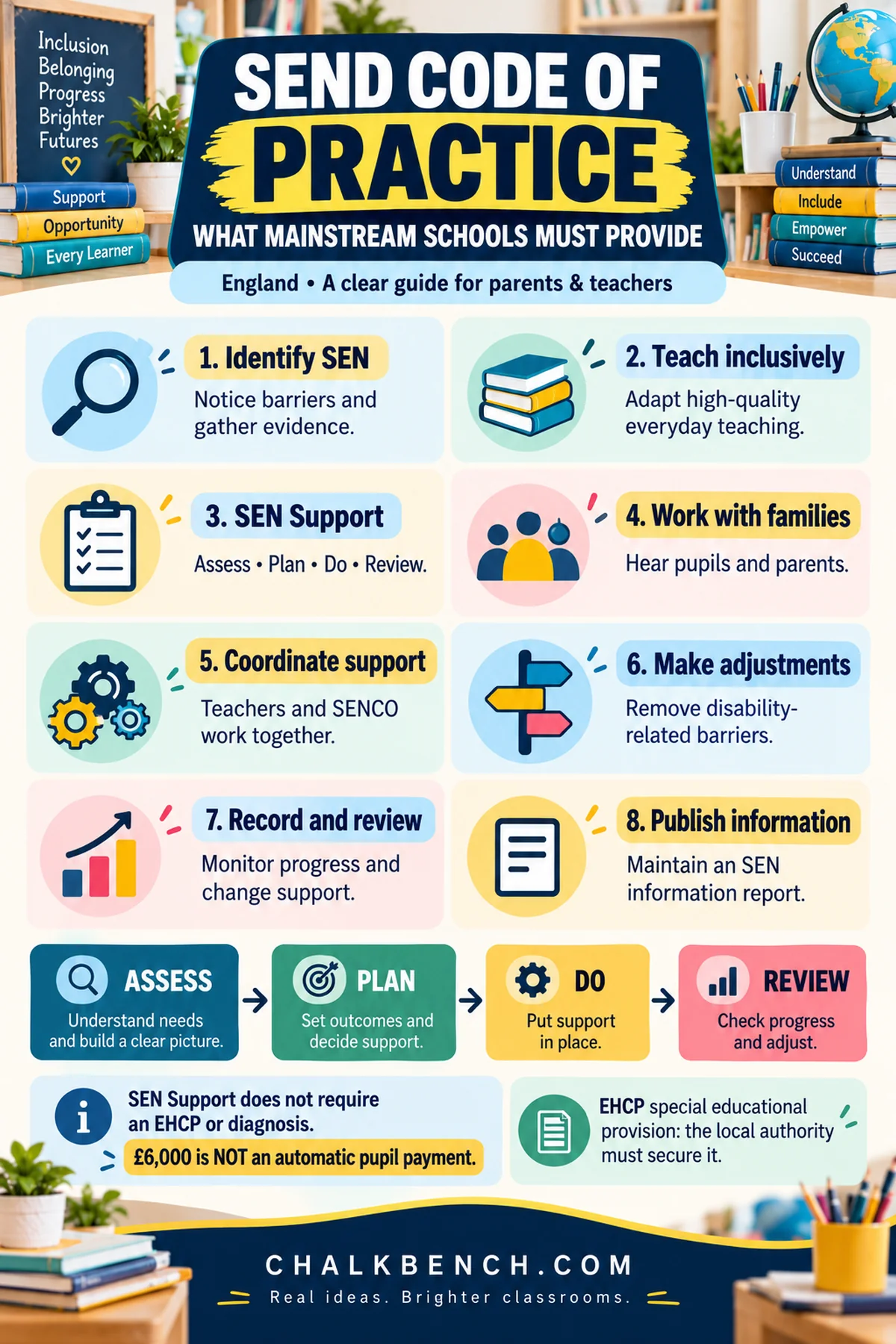
Use this checklist to translate the legal framework and Code guidance into everyday school practice. “Must” below describes a legal duty where one exists; other expectations reflect statutory guidance about how schools should discharge those duties.
| Responsibility | What it looks like in school |
|---|---|
| 1. Identify needs promptly | Notice barriers, use assessment information and talk with the pupil and family. Do not wait passively for a diagnosis. |
| 2. Teach inclusively | Provide high-quality teaching adapted to pupils’ needs, with additional targeted provision when required. |
| 3. Use SEN Support | Follow an ongoing Assess–Plan–Do–Review cycle and record what is tried and its impact. |
| 4. Involve families | Inform parents when special educational provision is made and seek pupil and parent views when planning and reviewing. |
| 5. Coordinate provision | Teachers retain responsibility for learning while the SENCO coordinates support across staff and services. |
| 6. Remove disability barriers | Consider reasonable adjustments, including changes to policies, assessment practices and auxiliary aids where reasonable. |
| 7. Monitor and review | Check whether support improves participation and outcomes; revise interventions when evidence shows they are not working. |
| 8. Publish SEND information | Maintain the school’s SEN information report and relevant accessibility information for families. |
A statement such as “We do not offer that support until the child has an EHCP” should prompt further questions. It may not reflect the school’s responsibilities to identify needs, make suitable SEN provision and consider adjustments now.
1. Start With High-Quality Teaching, Not a Separate Worksheet
The SEND Code of Practice places high-quality teaching, adapted for individual pupils, at the centre of the response to SEN. A teacher might provide visual instructions, explicitly teach vocabulary, chunk complex tasks, pre-teach key language or offer appropriate alternative ways to demonstrate learning. Additional interventions cannot make up for consistently inaccessible classroom teaching.
Identification should be informed by multiple sources: progress over time, learning observations, pupils’ experiences, work samples and parents’ concerns. A pupil getting average grades may still need support with communication, sensory access, organisation or attendance. Equally, one weak test result does not automatically establish SEN. The question is whether the pupil requires special educational provision that is additional to or different from provision generally made for peers.
2. SEND Code of Practice: Assess–Plan–Do–Review
In the SEND Code of Practice, the graduated approach is the practical heart of SEN Support. It is an ongoing cycle, not a fixed programme that every pupil must complete before anyone can request an EHC needs assessment.
Assess: build a clear picture
Identify strengths, barriers and the support already in place. Use teacher observations, relevant assessment data, pupil views and parent insight. Seek specialist advice where it is needed; an outside professional does not have to be involved in every initial adjustment.
Plan: agree outcomes and responsibilities
Choose a small number of meaningful outcomes and specify the provision: what will be taught, how often, who will deliver it and what success will look like. Tell the pupil and family what has been agreed. Set a review date and avoid phrases such as “some extra help” that nobody can check later.
Do: deliver what was planned
The class or subject teacher remains responsible for the pupil’s progress even when teaching assistants or specialists deliver parts of an intervention. Teachers and the SENCO should monitor implementation, including whether the support is actually accessible in ordinary lessons.
Review: assess impact and change course
Compare progress with the starting point, discuss what the pupil experienced and decide whether to continue, adapt or replace the provision. Schools should have meaningful conversations with families; the Code recommends meeting parents of pupils receiving SEN Support at least three times a year. This is statutory guidance that schools must consider and explain any departure from, rather than a separate statutory rule prescribing three identically formatted meetings (paragraph 6.65).
Classroom example: A Year 4 pupil struggles to decode unfamiliar words. The teacher records an initial 6/20 score on a comparable decoding probe, agrees explicit reading practice and classroom access supports, and checks progress weekly. After six weeks, the team reviews the trend with the child and parent. The dates and figures here are hypothetical teaching examples, not mandatory government thresholds.
3. Understand Who Does What: Teacher, SENCO and School Leaders
Class and subject teachers plan accessible teaching, implement appropriate support, track learning and communicate with colleagues. Being allocated a teaching assistant does not transfer responsibility for the pupil’s education away from the teacher.
The SENCO coordinates SEN provision, advises staff, liaises with parents and services, and supports the school’s approach to assessing and reviewing provision. Under section 67 of the Children and Families Act, mainstream schools must designate a SEN coordinator. The mandatory SENCO qualification became the NPQ for SENCOs for relevant new appointees from September 2024, with transitional arrangements and exemptions for certain previously qualified SENCOs. See the Department for Education’s qualification guidance.
Leaders and governing bodies or academy trusts are responsible for ensuring that staff, systems and resources enable duties to be discharged. Effective SEND provision should not depend on a single enthusiastic teacher or a parent repeatedly asking for the same adjustment.
4. SEND Code of Practice and Reasonable Adjustments
Alongside the SEND Code of Practice, the Equality Act requires schools to make reasonable adjustments to prevent disabled pupils being placed at a substantial disadvantage. This is an anticipatory duty. Depending on the barrier, this may mean changing a behaviour or homework rule, allowing an accessible way to communicate, providing appropriate auxiliary aids or changing how a task or test is delivered. Reasonableness depends on the circumstances, effectiveness and other relevant factors; it is not a guarantee of every requested item.
Schools have wider accessibility-planning duties relating to the physical environment and access to information. Do not confuse these with a blanket rule that every individual physical alteration must be made immediately as a reasonable adjustment. Pupils should also have meaningful access to wider school life and activities without unjustified disability-related exclusion.
Reasonable adjustments and SEN Support are related but not interchangeable. A pupil may need an adjustment because of disability without needing an EHCP; a pupil with SEN may also require targeted teaching through the graduated approach.
5. SEND Code of Practice: SEN Support and EHCPs
SEN Support is school-based support for pupils whose needs call for provision additional to or different from what is ordinarily provided. It does not require an EHCP. Schools should keep working on identified needs while an assessment request is considered.
An Education, Health and Care Plan is a legally binding plan for a child or young person whose special educational provision needs to be secured through an EHC plan. Under section 42 of the Children and Families Act 2014, the local authority must secure the special educational provision specified in the plan. The school ordinarily implements provision day to day and cooperates with the local authority; the legal duty on the authority remains.
A parent can request an EHC needs assessment directly from the local authority, without first securing the school’s permission. The threshold for an assessment is not “three failed terms” or a compulsory number of completed support cycles. For a practical explanation, see our guide to requesting an EHCP assessment in England.
Schools and families should review needs and provision even when an EHCP exists. The local authority must review the plan at least annually; the Code recommends considering reviews every three to six months for children under five, and transition reviews have additional requirements.
6. SEND Code of Practice: The £6,000 Funding Threshold
No. The often-quoted £6,000 is an additional-cost funding threshold used within England’s mainstream-school high-needs funding arrangements. It is not a personal allocation, a school invoice parents can demand, or a ceiling on a pupil’s entitlement to appropriate provision. The Department for Education’s 2026–27 notional SEN budget guidance specifically explains that schools do not receive £6,000 for every pupil with SEN.
Schools draw on delegated resources and the notional SEN budget; where additional costs exceed the applicable threshold, local authority top-up funding may be relevant. Families should focus discussions on identified needs, suitable provision and delivery, rather than assuming that a child has a fixed cash entitlement.
7. SEND Code of Practice: The SEN Information Report
The SEND Code of Practice explains the SEN information report that maintained schools and academies must prepare under section 69 of the Children and Families Act. It should be accessible on the school’s website, updated annually and amended promptly when information changes. The report helps parents understand how the school identifies and supports pupils, engages families, assesses progress, makes arrangements for disabled pupils and handles transitions.
Parents can use the report as a conversation starter: “Which support route applies to my child?”, “How does the school review progress?”, and “Who should I contact when agreed support is not happening?” The report does not replace an individualised plan or absolve the school from responding to the pupil’s actual needs. See the DfE publication guidance.
What Can Parents Do When Support Is Missing?
Use the SEND Code of Practice to frame a constructive meeting with the class or subject teacher and SENCO. Ask to see the evidence of need, the provision currently in place and the date progress will be reviewed. Keep a dated record of agreed actions and examples of when barriers arise. If concerns remain, use the school’s complaints process, seek independent information from the local SEND Information, Advice and Support Service (SENDIASS), and consider whether an EHC needs assessment is appropriate.
Copyable parent email template:
Subject: Request to discuss SEN Support for [child’s name]
Dear [teacher/SENCO],
I would like to meet to discuss [child’s name]’s needs in [area], the barriers they are experiencing and the support currently being provided. Could we review the assessment evidence, agree any necessary adjustments or targeted provision, and confirm how progress will be monitored and when we will meet again? Please also share the relevant SEN information report or support-plan details. Thank you for working with us.
Kind regards,
[Parent or carer]
At the meeting, ask five practical questions: What is the current baseline? Which adjustments already help? What provision will be delivered, how often and by whom? What evidence will show that it works? When will the pupil and family review it together? Request written notes to avoid misunderstandings.
SEND Code of Practice and the 2026 Reform Proposals
England’s 2026 schools white paper and SEND reform consultation describe proposed changes, including new Individual Support Plans and wider specialist provision arrangements. The existence of a proposal does not by itself replace the 2015 Code or amend a school’s existing statutory duties.
As of this article’s October 2026 source review, the official GOV.UK publication continues to list the 2015 Code as current statutory guidance. Schools should check for enacted law and updated government guidance before changing local procedures; families should not be told that proposed future rules have already removed present rights.
Frequently Asked Questions About the SEND Code of Practice
Does every pupil with SEN need an EHCP?
No. Many pupils receive school-based SEN Support. An EHCP is for situations where provision needs to be secured through a statutory plan. The local authority applies the statutory assessment test: whether the child has or may have SEN and may need provision made through an EHC plan.
Can a school wait for an autism or dyslexia diagnosis before helping?
A diagnosis is not a general prerequisite for identifying SEN, arranging appropriate SEN Support or considering reasonable adjustments. Schools should respond to needs and barriers supported by available evidence.
Is the SENCO solely responsible for teaching pupils with SEND?
No. The SENCO coordinates and advises, but classroom teachers remain responsible for their pupils’ learning and progress, including when other staff help deliver support.
How frequently should SEN Support be reviewed with parents?
The SEND Code of Practice says schools should meet parents of pupils receiving SEN Support at least three times each year; schools must consider this guidance and explain departures. Reviews should be meaningful and informed by evidence, not simply a tick-box exercise.
Must schools provide a one-to-one teaching assistant on request?
Not automatically. Support should follow assessed need, reasonable adjustments and any specific enforceable EHCP provision. One-to-one assistance may be appropriate in some cases but is not guaranteed for every pupil with SEND.
Who is responsible when an EHCP’s Section F provision is not delivered?
The local authority has the legal duty to secure the specified special educational provision under section 42. Families should raise delivery concerns promptly with the school and local authority and seek tailored advice if the issue continues.
Is £6,000 paid to each pupil with SEND?
No. It is a funding threshold for additional support costs in mainstream-school arrangements, not an automatic individual allowance. Provision should be determined by need and applicable legal duties.
Does the SEND Code of Practice apply throughout the UK?
No. The English SEND Code applies in England. Wales, Scotland and Northern Ireland have separate systems, guidance and terminology.
Putting the SEND Code of Practice Into Action
The SEND Code of Practice is not a promise of identical support for every pupil. It is part of a framework requiring schools to take need seriously, make appropriate provision, work with children and families, and review whether support is effective. The most useful question for your next school meeting is simple: What has been identified, what is being delivered, and how will we know it helps?
Authoritative Sources and Further Reading
- Department for Education — SEND Code of Practice: 0 to 25 Years.
- Children and Families Act 2014 — section 66, best endeavours; section 42, EHCP special educational provision; section 69, SEN information reports.
- GOV.UK — Reasonable adjustments and disability in education.
- Department for Education — Mandatory SENCO qualification.
- Department for Education — Notional SEN Budget 2026–27.
- Department for Education — SEND reform consultation (2026).
Editorial note: This article is general information about SEND in England, not legal advice or an individual assessment. School arrangements and enacted law can change. Reviewed on 25 October 2026 for ChalkBench by M. Danish.