
US & UK • Classroom Support
Quick answer: Useful ADHD accommodations in the classroom remove avoidable barriers to attention, planning, movement, and task completion without automatically lowering the learning goal. When choosing ADHD accommodations, start with clear directions, smaller task steps, predictable routines, movement opportunities, and discreet feedback. Then check whether those supports make a difference for that particular student.
This guide gives primary/elementary, middle/secondary, and special education teachers 15 low-cost, actionable adjustments, concrete examples of what to say or prepare, and a simple way to review progress. These ADHD accommodations are options to personalise, not a package that every learner with ADHD needs. The suggestions are informed by school guidance from the US Centers for Disease Control and Prevention (CDC), the UK’s NICE ADHD guideline, and inclusive teaching principles from EEF and CAST.
Scope: Classroom practice for US and UK educators. US IEP/Section 504 and England SEND arrangements are different legal systems; a support you try informally does not replace an agreed plan or its required services. This article does not diagnose ADHD or advise on medication.
In this guide
What are ADHD accommodations in the classroom?
An accommodation changes how a learner accesses instruction or shows what they know. For example, a student might hear directions while reading them, use a timer to see the next checkpoint, or type a response instead of writing it by hand when handwriting is not the skill being assessed. An accommodation is not necessarily a change in the intended academic standard.
A modification changes the learning expectation itself, such as assessing an easier objective in place of the scheduled standard. Sometimes a student’s individual programme calls for modifications, but teachers should not quietly replace academic expectations with easier work merely because ADHD is mentioned. First identify the barrier and the learning goal, and involve the student’s support team where required.
ADHD can affect sustained attention, working memory, inhibition, planning, initiation, or self-regulation in different combinations. Some students move frequently; others may appear quiet yet spend enormous effort following a multi-step explanation. Observe what happens during a specific task, ask the student what helps, and avoid judging needs from a label alone. NICE highlights the role of environmental adjustments and collaboration with education settings; CAST likewise emphasises scaffolds for planning and monitoring.
15 ADHD accommodations at a glance
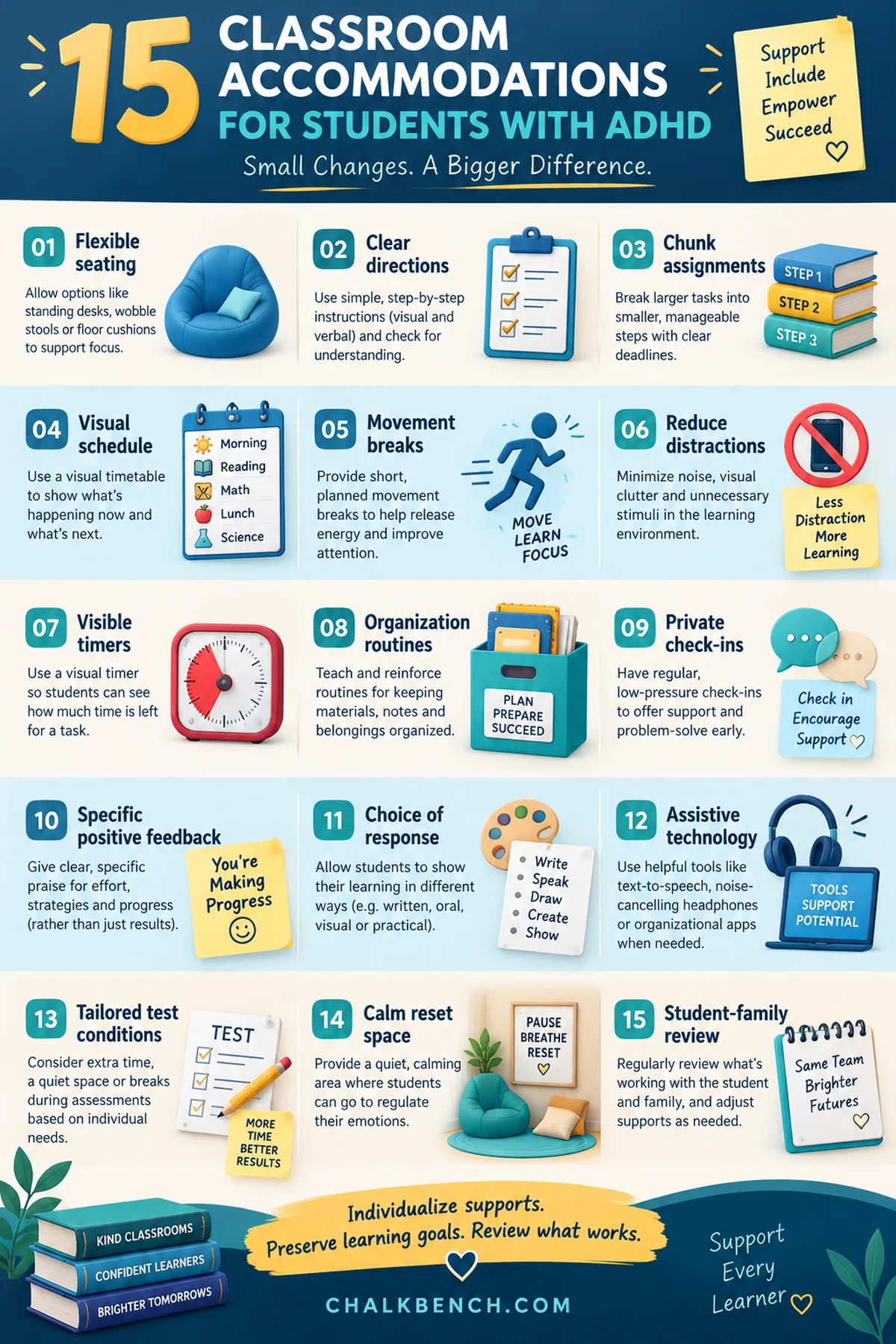
If you have only five minutes before a lesson, use this quick-reference table of ADHD accommodations. The fuller sections below explain how to make each adjustment specific rather than vague.
| # | Accommodation | Start with this | Look for |
|---|---|---|---|
| 1 | Flexible seating | Agree a lower-distraction seat or standing option. | More time engaged with the actual task. |
| 2 | Clear directions | Give one step at a time in speech and writing. | Fewer restarts after instructions. |
| 3 | Chunk assignments | Divide a longer task into three checkpoints. | More stages completed independently. |
| 4 | Visual schedule | Display “now, next, later” and transition cues. | Smoother starts and transitions. |
| 5 | Movement breaks | Plan short, purposeful breaks with return cues. | Easier re-entry into learning. |
| 6 | Reduce distractions | Clear surplus materials and offer a quieter spot. | Reduced off-task interruptions. |
| 7 | Visible timers | Mark the next checkpoint, not just the deadline. | More predictable pacing. |
| 8 | Organization routines | Teach a two-minute pack-and-check sequence. | Fewer missing materials or steps. |
| 9 | Private check-ins | Use a discreet start/midpoint check. | Earlier resolution of confusion. |
| 10 | Specific positive feedback | Name the strategy or behaviour that worked. | More repeated useful behaviours. |
| 11 | Choice of response | Offer typed, spoken, or visual responses where valid. | Clearer evidence of understanding. |
| 12 | Assistive technology | Trial one approved tool for a defined barrier. | Less friction completing the work. |
| 13 | Tailored assessment conditions | Consider approved extra time or a quiet room. | Fairer access to the skill being measured. |
| 14 | Calm reset space | Set up a voluntary, predictable regulation option. | Safe, supported return to learning. |
| 15 | Student–family review | Review one goal with the student and support team. | Decisions based on actual observations. |
15 practical ADHD accommodations teachers can try
1. Offer flexible seating based on the task
When it helps: When nearby conversations, a doorway, or the need to move makes concentrating difficult. Flexible seating within ADHD accommodations does not mean automatically placing every student with ADHD in the front row. Some do well near the teacher; others prefer a side desk, an ordinary chair with a footrest, or a short standing work period.
Try it tomorrow: Let the student try two school-approved locations for the same kind of independent task. Explain the goal privately: “We’re looking for a place where you can get started and keep going.” Ask which position feels workable and maintain a route for taking part in group teaching.
Check: Compare how long the student stays meaningfully engaged or how many task steps they complete—not how still they look. Avoid conspicuous placement that identifies the student to peers.
2. Give clear verbal and written directions
When it helps: A learner may understand the content but lose part of a spoken three-step instruction. For ADHD accommodations, visible directions provide a more useful starting point than repeatedly saying “pay attention.”
Try it tomorrow: Display the task in numbered language: “1. Open page 12. 2. Underline two examples. 3. Explain one example.” Say the first instruction aloud and point to its written counterpart. For younger students, add familiar icons; for older students, a concise checklist in the learning platform may be enough.
Check understanding respectfully: “Tell me which step you are starting with,” rather than asking, “Were you listening?” If the content is new, model the first example. EEF’s explicit instruction approach supports modelling and guided practice before expecting full independence.
3. Chunk longer assignments into visible milestones
When it helps: A page of twenty questions or an extended writing prompt may feel like one undefined task. Smaller, well-chosen checkpoints clarify where to begin and when progress is happening.
Try it tomorrow: Keep the same objective but divide the page into three sections with mini-headings: “Plan,” “First attempt,” and “Review.” Give the student a single completion target: “Complete questions 1–4; then show me your approach.” Uncover the next section after the first is underway if seeing the whole page creates overload.
Check: Look for faster task initiation and more completed steps. ADHD accommodations such as chunking should scaffold the full learning goal rather than silently cutting essential content. Gradually fade the prompts as independence grows.
4. Use a visual schedule and transition warnings
When it helps: Switching between reading, group discussion, and independent work may be harder when transitions arrive without warning. Predictable ADHD accommodations can reduce the executive-function demand of figuring out what happens next.
Try it tomorrow: Put a simple “Now / Next / Later” routine on the board and update it as the lesson unfolds. Two minutes before a change, give a consistent cue: “We have two minutes to finish this step; next we’ll discuss our answers.” If the timetable changes, name what has changed and what has stayed the same.
Check: Observe time needed to start the next task. Avoid rigidly insisting that every student follows an identical routine regardless of their sensory or learning needs.
5. Schedule purposeful movement breaks
When it helps: Sitting continuously can add unnecessary friction to an already demanding task. Movement-based ADHD accommodations may give a student a chance to reset, but the preferred frequency and activity differ between learners.
Try it tomorrow: Offer a predictable two-minute walk to collect materials, a standing stretch, or an agreed errand between work segments. Pair the break with a return cue: “After the stretch, put your name on your second paragraph.” Make the same neutral movement options available to other pupils when practical.
Check: Look at the student’s ability to resume purposeful work after the break. Do not withdraw a necessary movement accommodation as a punishment, and agree any safety boundaries in advance.
6. Reduce unnecessary visual and sound distractions
When it helps: Busy wall displays, multiple worksheets, notifications, or chatter can compete with the task. With distraction-reducing ADHD accommodations, the aim is not an entirely silent classroom; it is giving the learner a workable level of input.
Try it tomorrow: Put only the current materials on the desk, minimise pop-up alerts on school devices, and offer access to a quieter seat for independent reading or assessment where permitted. A small privacy board or reduced-clutter worksheet may help some pupils, but not everyone wants headphones or isolation.
Check: Ask the learner whether the change reduces interruptions and compare work quality or task starts. Keep opportunities for collaboration and inclusion intact.
7. Make time visible with manageable checkpoints
When it helps: A student who has difficulty estimating elapsed time may start too late or spend most of a period perfecting the first question. Visual time cues can make the next step concrete.
Try it tomorrow: Use a visual timer, a small countdown on the board, or a checklist with two target times: “Plan until 10:10; draft until 10:25.” Give a gentle halfway reminder rather than a series of stressful countdowns. Let the student choose a timer that is helpful and not distracting.
Check: Monitor whether the student begins earlier and reaches checkpoints. Within ADHD accommodations, a timer is a planning scaffold, not a threat or a substitute for individually required extended time.
8. Explicitly teach an organization routine
When it helps: Losing a worksheet, forgetting a step, or arriving without materials may reflect difficulty with organization rather than lack of care. The CDC identifies organizational training as a school-based approach with evidence of benefit.
Try it tomorrow: Teach one repeatable routine: “Before leaving, check your folder, planner, and pencil case.” Post three corresponding symbols near the exit and demonstrate the sequence. For older students, use one assignment tracker with a clear due date and a five-minute weekly reset, rather than several systems in different apps.
Check: Count items missing or tasks forgotten over a short baseline and trial. Reduce adult prompting once the student can use the checklist themselves; teach the routine as part of ADHD accommodations rather than just telling them to “be organized.”
9. Use discreet check-ins before problems escalate
When it helps: Some students will not ask a question publicly and may sit quietly without starting. ADHD accommodations such as low-pressure check-ins can identify uncertainty while preserving dignity.
Try it tomorrow: Agree a private signal—such as a card turned over, a quick thumbs-sideways sign, or a brief desk visit—at the start and midpoint of independent work. Ask: “What is your first step? What might get in the way?” Offer the smallest helpful prompt, then give the student room to continue.
Check: Note fewer abandoned tasks or faster recovery from confusion. Avoid hovering over the student throughout the activity or discussing a disability in front of peers.
10. Give specific, timely, positive feedback
When it helps: A child may hear general corrections more often than clear explanations of what they did successfully. Feedback within ADHD accommodations can reinforce the exact strategies that support learning.
Try it tomorrow: Replace “Good job!” with “You checked the instructions and completed the first two steps before asking for help.” Keep praise sincere, brief, and age-appropriate. Where a structured behaviour plan or daily report card is part of a student’s agreed support, follow its specific goals and involve the relevant trained staff.
Check: Look for the targeted behaviour appearing more often, such as initiating independent work within a few minutes. The CDC describes positive behavioural classroom management and clear feedback as promising school supports; it also cautions that evidence for individual accommodations varies.
11. Offer a valid choice of how to respond
When it helps: A student may understand a scientific idea but struggle to write an extended explanation, or may communicate more clearly using a diagram with labels. ADHD accommodations that offer response flexibility can reduce a barrier, provided the assessment still measures the same skill.
Try it tomorrow: For a lesson about explaining a process, invite students to type, speak briefly, draw and label, or write—using the same content rubric. Make a note where handwritten writing is actually the target: in a handwriting lesson, a spoken explanation cannot simply replace the required evidence.
Check: Compare the quality of the explanation against a common learning objective. CAST’s UDL framework encourages multiple ways to express learning without assuming a particular mode works for everyone.
12. Trial assistive technology for one clearly defined need
When it helps: Digital supports can reduce friction with reading, spelling, remembering instructions, or organizing assignments. Technology-based ADHD accommodations are useful only if they solve a real access problem and do not introduce more distraction.
Try it tomorrow: Trial a school-approved text-to-speech function for longer directions, speech-to-text for drafting where permitted, or a simple digital checklist. Give the student direct instruction in how to use it and test the workflow before the lesson. Use a non-sensitive example when checking a new tool.
Check: Does the learner complete more of the target task with less adult assistance? Check accessibility, age suitability, device restrictions, and student-data privacy. Do not upload identifiable student records to an unapproved AI service. ChalkBench’s guide to differentiated materials explains how to change access while preserving the learning goal.
13. Tailor assessment conditions rather than assuming extra time
When it helps: Timed tests, distracting venues, or lengthy written responses can interfere with demonstrating knowledge. Suitable ADHD accommodations for assessment follow the student’s actual needs and the rules of the assessment.
Try it tomorrow: Review the agreed IEP, Section 504 plan, school SEND plan, or relevant exam arrangements. A student may need extended time, breaks, a smaller testing room, access to a reader, or another adjustment. Check whether the change is allowed for that particular test and what skill it is intended to measure.
Check: Determine whether the arrangement better reveals mastery—not whether it produces an artificially higher score. Avoid promising that every standardized or external exam will permit an adjustment simply because it is used in ordinary classwork.
14. Provide a calm, voluntary reset option
When it helps: A student becoming overwhelmed may benefit from a predictable way to pause and return. A calm reset option within ADHD accommodations is not a punishment, isolation room, or substitute for appropriate adult support.
Try it tomorrow: Agree a short protocol with the learner and, where appropriate, the support team: signal for a reset, use a calm designated space or brief activity, then choose the next manageable task step. Keep the area observable and compliant with safeguarding procedures. Make sure access does not depend on earning the privilege through compliant behaviour.
Check: Note whether the student re-engages safely and feels respected. If distress is frequent or severe, involve the school’s trained support staff and family rather than relying on the space alone.
15. Review the supports with the student and family
When it helps: ADHD accommodations can look good on paper yet be inconvenient, stigmatizing, or ineffective in a real classroom. The most sustainable plans combine classroom observation with the student’s own experience and regular communication.
Try it tomorrow: Choose one or two concrete targets and schedule a short review. Ask the learner: “What helped you get started?” and “What support would you change?” Share a concise, respectful update with the family and relevant team through approved channels, keeping private information out of public class records.
Check: Continue, refine, or discontinue a trial based on the outcome, while following any existing legal plan. Student choice is important, but support-plan services should not be removed without the required team process.
ADHD accommodations during a real school day
Elementary/primary example: An independent writing block
The learning goal is to write a paragraph explaining why a character made a decision. At the start of the lesson, the teacher displays the objective and models a brief answer. One student has a short checklist: “Choose evidence → explain it → reread.” The student chooses a low-distraction seat, works toward a ten-minute checkpoint, and has permission to take an agreed movement break before the final reread. The teacher gives a quiet prompt after the first sentence and specific feedback about using evidence. Nothing here requires the entire class to complete easier writing; the student is working towards the same idea with a clearer route.
Middle/secondary example: A science investigation
The shared objective is to explain the relationship between two measured variables. The teacher prints the method as numbered steps, posts a timing plan, and asks each group member to take a rotating role. A student uses a folder for data sheets, receives a midpoint check, and submits a labelled graph plus an oral explanation if that is consistent with the rubric. At the end of the lesson, everyone checks the same scientific reasoning. The team later reviews whether the prompts helped without making the student dependent on constant adult reminders.
How to review ADHD accommodations over two weeks
Trying all 15 ADHD accommodations at once makes it hard to know what helped. A small trial of ADHD accommodations is easier for busy teachers and more respectful to the learner.
- Define the barrier. For example: the student starts independent work late, not “the student is unmotivated.”
- Record a brief baseline. Over two or three comparable lessons, note minutes until the first task step, number of steps completed, or occasions when materials are missing. Use ordinary school-approved records.
- Choose one or two supports. Match them to the barrier: written directions and chunking for task initiation, for example. Check the student’s existing plan before making changes.
- Use the approach consistently. Apply it during comparable tasks for roughly two school weeks. This is a practical review interval, not a clinically validated threshold.
- Review both numbers and experience. Compare similar tasks, ask the student whether the support helped, and look for unintended effects such as embarrassment or added work.
- Decide together. Keep what works, adjust what does not, and involve the responsible IEP/504 or SEND team for formal changes.
| Barrier | Support to trial | Simple observation | Review question |
|---|---|---|---|
| Slow task start | Written first step + check-in | Minutes until first step begins | Is the learner starting with less prompting? |
| Missing materials | Three-item pack-up checklist | Number of essential items missing | Can the student use the routine independently? |
| Transition difficulties | Now/next visual + warning | Time to settle into the next task | Do transitions feel calmer to the learner? |
| Incomplete long task | Three small checkpoints | Checkpoints completed on comparable work | Is the full learning objective still covered? |
Keep measurement humane: Do not treat sitting perfectly still, looking directly at the teacher, or suppressing natural movement as the goal. Record meaningful access to learning, safety, independence, and student wellbeing instead.
ADHD accommodations in US IEP/504 and England SEND support
United States: IEPs and Section 504 plans
In the US, eligible students may receive support through an Individualized Education Program (IEP) under IDEA or services and accommodations under Section 504, depending on their individual circumstances and legal eligibility. ADHD alone does not automatically establish eligibility for a particular plan; the student’s needs and an appropriate evaluation matter. A Section 504 assessment also does not require a medical diagnosis as an automatic prerequisite, according to the US Department of Education’s guidance.
Classroom teachers should know which ADHD accommodations and other supports the student’s actual plan requires, implement them consistently, and raise concerns promptly with the responsible team. An informal classroom idea is not a replacement for written obligations. ChalkBench’s IEP vs. 504 plan guide explains the differences for US parents. Ask the 504 coordinator, special educator, case manager, or family if it is unclear whether a proposed change is appropriate.
England: SEN support and reasonable adjustments
In England, schools can use graduated SEN support and may have duties to make reasonable adjustments under equality law where the child meets the legal disability definition. Some children have an education, health and care (EHC) plan for more complex needs. Teachers should work with the school’s SENCO, parents or carers, and the student to implement agreed provision and review the impact. For the broader legal framework, read ChalkBench’s England EHCP assessment guide. See GOV.UK’s SEND overview and reasonable-adjustments guidance.
The UK consists of four education systems with different SEND processes, so England’s EHC plan terminology should not be assumed to apply in Scotland, Wales, or Northern Ireland. Across contexts, follow local policy, the student’s rights, and the specific support arrangements in place.
Common mistakes when choosing ADHD accommodations
- Using every adjustment for every learner. Start with the barrier and student feedback; review the fit.
- Equating quietness with learning. A silent child may still be confused, while a moving child may be listening closely.
- Removing the challenge instead of the obstacle. Keep the learning objective clear unless an agreed individual programme calls for something different.
- Using rewards as a public scoreboard. Feedback should build useful skills without shame, public labels, or constant comparison with classmates.
- Assuming a diagnosis guarantees a specific plan. Eligibility, appropriate evaluation, and required provision differ by jurisdiction and student.
- Introducing too many apps. Tools can be distracting, and sending identifiable pupil information to unapproved platforms creates privacy risks.
- Changing written supports without the team. Follow the required process for an IEP, 504 plan, EHC plan, or other agreed provision.
Frequently asked questions about ADHD accommodations
What are the most helpful classroom accommodations for ADHD?
Often useful starting points are clear instructions, visible steps, organizational coaching, predictable routines, appropriate movement opportunities, and specific feedback. There is no single “best” combination for all students. Match the support to a clear learning barrier and review whether the student benefits.
Should every student with ADHD get extra time on tests?
No. Extra time may be appropriate for some learners, but it is not an automatic requirement for every student with ADHD. Testing accommodations must reflect individual needs, the applicable plan, and assessment rules. Other adjustments, such as reduced distractions or planned breaks, may be more useful.
Are these strategies only for students with a formal diagnosis?
Teachers may use many universal, inclusive approaches—such as clear directions and visual schedules—with any students who benefit, while following school policy. Access to specific legally required services or plans depends on the relevant rules and individual evaluation; a diagnosis is not always a prerequisite for a Section 504 evaluation.
Are classroom accommodations the same as modifications?
Not necessarily. An accommodation changes access, timing, setting, or response format while preserving the intended assessment target. A modification changes the target or level of expectation. The distinction matters for fair grading and individual support planning.
Does flexible seating mean using a wobble stool or fidget tool?
No. Flexible seating can be an ordinary chair in a better location, an agreed standing option, or a workspace with fewer interruptions. Specialist furniture and fidgets are not required, and some students find them distracting. Trial the least complicated useful choice first.
Can a teacher use these accommodations in a UK primary school?
Yes, many of the teaching approaches are relevant to UK primary classrooms. In England, coordinate individual SEND provision and reasonable adjustments with the SENCO and the family. Requirements and terminology differ across the four UK nations, so check local arrangements.
How can I tell whether an accommodation is working?
Define one meaningful target—such as beginning work independently or completing a sequence of instructions—and compare observations during similar lessons. Ask the student about comfort and usefulness. Continue or change a trial based on progress, without changing formal plan commitments unilaterally.
What should teachers do when a student still struggles despite accommodations?
Review whether the task, instruction, and support match the learner’s needs. Involve the special education/SEND team, student, and family, and consider whether further evaluation or different provision is warranted. Do not assume that a lack of improvement is unwillingness or misconduct.
Choosing ADHD accommodations: individualise, teach and review
Effective ADHD accommodations are usually practical, specific, and revisable. A student who can see the first step, move without stigma, ask for a private check-in, and demonstrate understanding in an appropriate format may be able to participate more fully in the same meaningful learning task. Choose one barrier, make one manageable change, and ask the learner whether it genuinely helped.
For another approach to preserving a shared learning goal while adapting materials, read ChalkBench’s AI tools for differentiated instruction guide. Use the school’s approved systems and never put identifiable student records into a general-purpose tool without authorisation.
Sources, evidence and editorial scope
Prepared for ChalkBench by M. Danish. Editorial review date: 11 October 2026. This is a research-informed teaching guide based on public official and evidence-informed resources, not a report of firsthand classroom trials or an endorsement by CDC, EEF, NICE, or any professional association. The CDC notes that evidence on the effectiveness of individual ADHD accommodations remains limited; evidence is stronger for structured behavioural classroom management and organisational training. Adapt each suggestion to the individual and follow local policy and legal requirements.
- CDC — ADHD in the Classroom (June 2026)
- CDC — Clinical Care of ADHD in Children
- US Department of Education, OCR — Disability Discrimination FAQ
- US Department of Education — Section 504 FAPE FAQ
- NICE — ADHD: Diagnosis and Management (NG87)
- Education Endowment Foundation — Supporting Pupils with SEND
- CAST — UDL Guidelines 3.0
- GOV.UK — Special Educational Needs and Disabilities
- GOV.UK — Education Support and Reasonable Adjustments