AI text levelers for teachers should make a passage easier to access while keeping the facts, relationships, and subject vocabulary your lesson needs. Choose by the controls you can review and the output you can edit. A lower grade-level label alone does not show that the rewritten passage is accurate or suitable for a particular student.
Brisk, Revision Genie, and TeachShare offer different starting points. Below is a documentation-based comparison and a practical way to check an adaptation. We reviewed official pages on September 23, 2026, and inspected Revision Genie’s live tool screen. We did not complete a common-passage generation test across all three tools, so we do not rank their output quality.
Choose AI text levelers for your starting material
| Tool | Documented workflow | Check before choosing |
|---|---|---|
| Brisk Change Level | Start from a document or webpage, open the extension, choose Change Level, and select a grade level. Brisk describes creating a new document for further editing. | Whether your school permits the extension, whether it reads your source correctly, and whether the adapted document preserves the evidence needed for your questions. |
| Revision Genie | The product page describes original text, target reading level, and vocabulary preservation. The live screen showed age/year options, a Preserve Key Vocabulary checkbox, and a Highlight Major Changes option. | The live tool required sign-in and disabled generation during our check, despite the landing page advertising a trial without sign-up. Confirm access before building a lesson around it. |
| TeachShare | The public form takes a grade level and original text; submission continues into TeachShare’s workflow. | The account requirements, available editing/export route, and whether the output retains the content you specify. We have not verified generation or export. |
If you already work with supported browser documents, Brisk’s documented workflow is worth checking first. If explicit vocabulary and change-highlighting controls matter, inspect Revision Genie’s accessible account workflow. If you prefer starting with pasted text and a grade selector, evaluate TeachShare. These are workflow matches, not claims that one produces better reading material.
Define what must survive the rewrite
Before changing a passage, write a short preservation list. Include named people or places, quantities, comparisons, causes, exceptions, and the academic words being taught. Then identify the question students must still be able to answer using the adapted text.
For a science explanation, removing the word evaporation may remove the vocabulary objective. Keeping the word and explaining it in a short sentence may serve the lesson better. For a history source, rewriting a speaker’s wording can alter the evidence students are supposed to interpret. In that case, consider retaining the original quotation and adding a glossary or explanatory note.
Decide whether you need a shorter text, simpler sentence structure, vocabulary support, or a translated text. Those are different changes. Asking for all of them at once makes it harder to see why an important detail disappeared.
A worked meaning check using an original passage
The following example was written for this guide. It is an editorial demonstration, not output generated by any of the tools above, and it has not been validated at a particular reading age.
In a school trial, two identical trays each received 200 mL of water. One tray stayed in sunlight and the other stayed in shade for two hours. The sunny tray lost 30 mL; the shaded tray lost 10 mL. The class observed greater evaporation from the sunny tray, but this single trial did not establish that sunlight alone caused the difference.
A possible clearer version:
A class put 200 mL of water in each of two identical trays. One tray was in sunlight. The other was in shade. After two hours, the sunny tray had lost 30 mL of water. The shaded tray had lost 10 mL. More water evaporated from the sunny tray. Evaporation means liquid water changes into water vapor. This was only one trial. It did not prove that sunlight alone caused the difference.
The second version breaks up the sentences and explains the target term. It keeps the starting quantity, time, measured losses, and limit on the conclusion. It also adds a definition, which needs its own accuracy check because it was not stated in the original passage.
| Preserve | Acceptable change | Reject or repair |
|---|---|---|
| 200 mL in each tray | Move the quantity into a separate sentence. | Say the class used 200 mL in total. |
| 30 mL versus 10 mL lost | Describe each tray separately. | Swap the measurements or call them amounts remaining. |
| One trial; cause not established | Explain the limitation in everyday language. | Claim the trial proved sunlight was the only cause. |
| Evaporation | Retain and define the word. | Remove the word when it is the lesson’s vocabulary target. |
Use the same input to evaluate two tools
Choose a short passage you wrote or are permitted to adapt. Keep the source and your preservation list beside the output. Use the same passage, requested level, and instructions in each tool where the interface allows it. Record settings that differ; otherwise you may mistake a different request for better performance.
A reusable instruction is:
Adapt the passage for readers who need shorter sentences and clearer references. Keep all names, quantities, comparisons, and qualifications. Retain these target words: [list]. Explain them briefly without removing them. Do not add new evidence. Keep enough detail to answer this question: [question]. Separate any suggested teaching notes from the student passage.
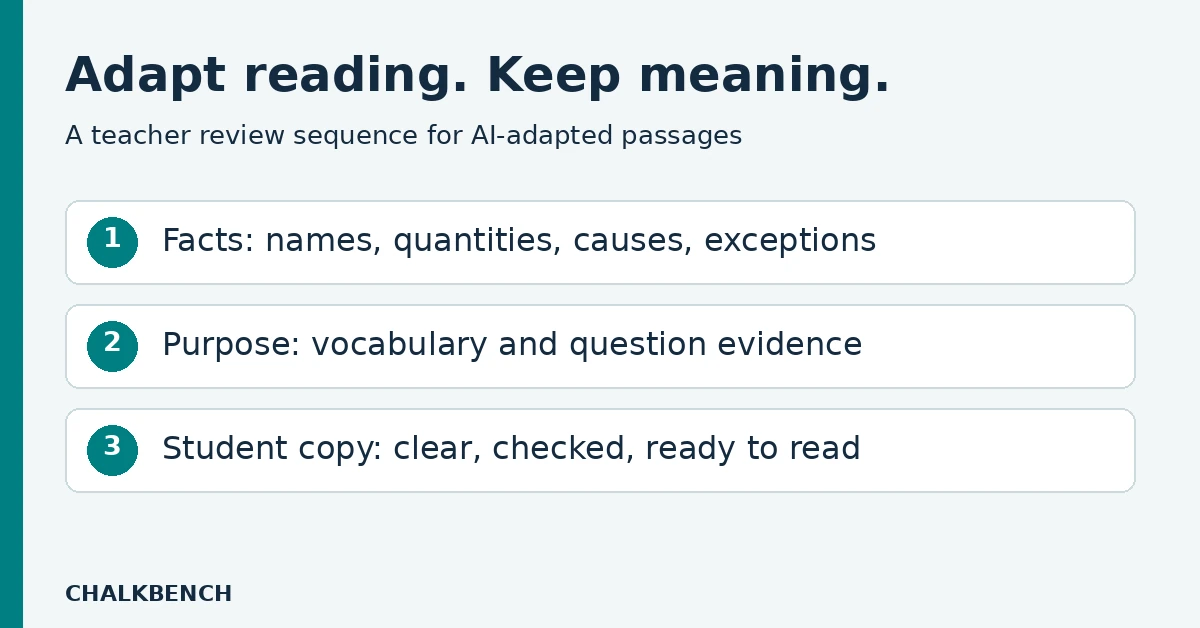
Review the result in three passes: facts first, lesson purpose second, and readability third. Mark every deleted or added claim. Ask the original comprehension question again. Finally, read the passage aloud and check pronouns, abrupt transitions, and unnecessary changes to tone.
A tool that saves a few editing steps on one passage may need substantial correction on another subject. Record corrections rather than assigning an unsupported overall score. Try a second source type before adopting the workflow for a full unit.
Handle US grades and UK year labels carefully
Use the level selector as a starting instruction, not an assessment of a student. Brisk describes US-style grade options. Revision Genie’s inspected screen used age/year combinations. Do not assume that matching numbers, such as Grade 5 and Year 5, represent the same classroom expectations.
For either setting, specify the content and language demands yourself. A reader may understand the topic well but need help with unfamiliar vocabulary. Another may decode the words yet need a diagram or background explanation. Review the passage against the students and the task rather than treating a single label as the decision.
Prepare the student version
- Keep a source copy and a separately named adapted copy.
- Remove editing notes, change markers, and teacher-only answers from the student handout.
- Check that questions refer to facts still present in this version.
- Use a neutral filename such as Water-trays-reading-B rather than a label identifying a student’s reading difficulty.
- Use school-approved tools and nonsensitive source material; a vendor’s marketing statement does not establish your school’s approval.
If you turn the passage into practice work, use our worksheet generator comparison to evaluate the next step. For an existing PDF, our PDF-to-worksheet guide explains why the printable student copy and answer key need separate checks.
Frequently asked questions
Is text leveling the same as summarizing?
No. A summary intentionally selects and condenses information. A leveled version may change the language while retaining the detail needed for the same lesson. Check the output because a tool can still omit important content.
Does a grade label certify the reading level?
This guide does not establish that any tool’s label is a validated assessment. Treat it as a requested target and review the actual passage. We have not independently measured the reading level or learning outcomes of these outputs.
Can I use an adapted passage for close reading?
First decide whether students are analyzing the original language. If word choice, voice, or sentence structure is the evidence, an adaptation changes that evidence. Keep the original available and label any support version clearly.
Evidence note: Official Brisk, TeachShare, and Revision Genie pages were checked September 23, 2026. Revision Genie’s tool interface was inspected without signing in. Generation quality, export behavior, paid limits, and classroom outcomes were not tested. The worked example and review checklist are ChalkBench editorial material.
Featured image: AI-generated conceptual illustration by ChalkBench; not an application screenshot or product test.