England • SEND Parent Guide
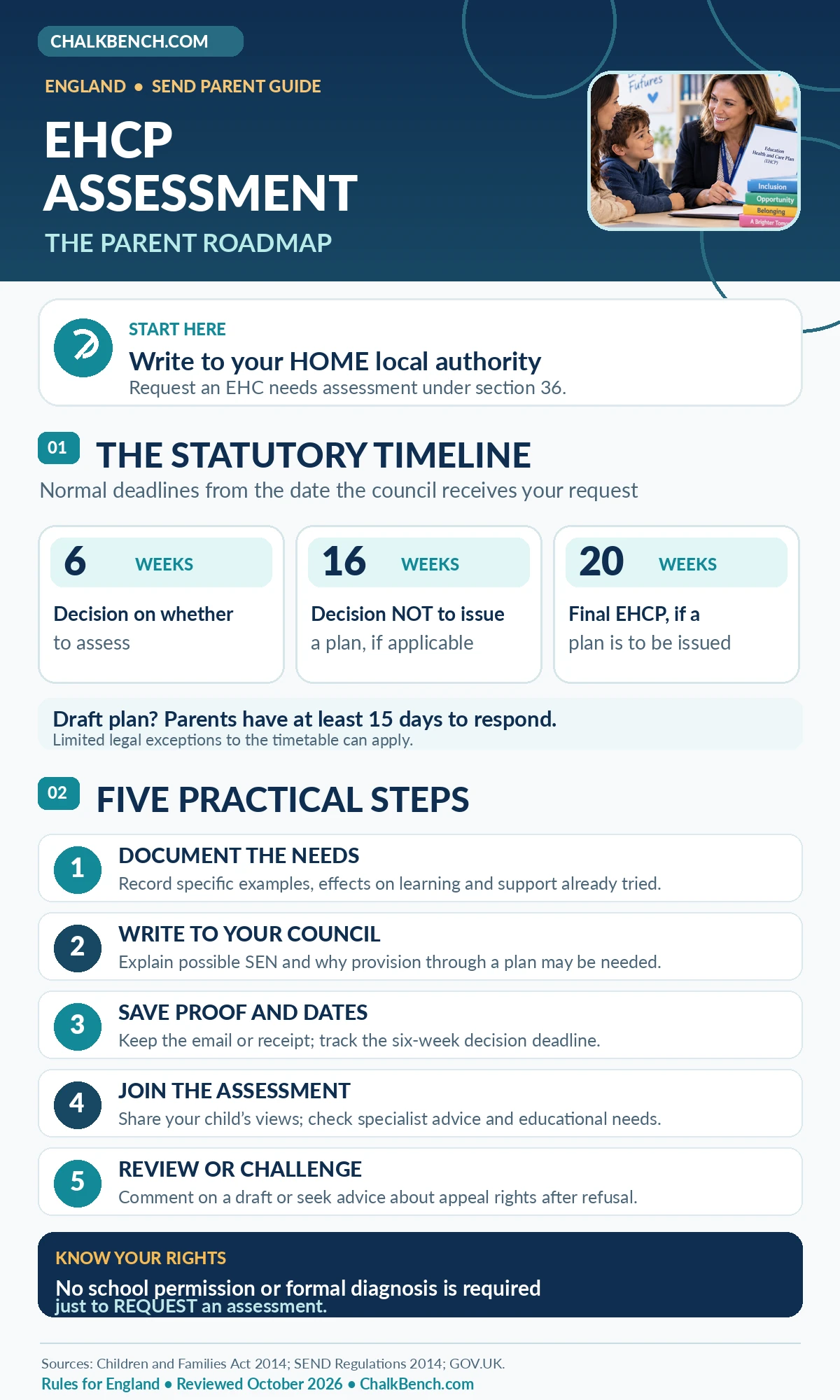
Quick answer: To request an EHCP assessment in England, write to the special educational needs and disabilities (SEND) team at your home local authority and ask for an Education, Health and Care (EHC) needs assessment under section 36 of the Children and Families Act 2014. Explain why your child has or may have special educational needs and why the support they require may need to be provided through an EHC plan. Include evidence you already have, keep a dated copy, and expect a decision on whether to assess within six weeks. If an EHC plan is needed, the normal statutory deadline for issuing the final plan is 20 weeks from the original request, subject to specified exceptions.
Requesting an EHCP assessment is not the same as securing an EHCP. The assessment establishes what a child or young person needs; the local authority then decides whether an enforceable plan is necessary. This practical guide explains how to request an EHCP assessment, from gathering evidence and writing your request to reviewing the draft and challenging an unfavourable decision.
Location matters: The EHCP framework described here applies to England. Wales, Scotland and Northern Ireland use different arrangements. Follow the steps below only if the child or young person is within the English system. GOV.UK confirms the different national routes.
In this guide
What is an EHCP — and what are you actually requesting?
An Education, Health and Care Plan (EHCP) is a legal document identifying a child or young person’s special educational needs, the provision required to meet those needs, and relevant health and social care provision. It is for children and young people who need support beyond what can ordinarily be provided through SEN Support. A plan can be used in a mainstream school, a specialist setting, or other appropriate education or training arrangements.
The first stage is an EHC needs assessment, sometimes called an EHCNA. It is a statutory process run by the local authority to gather advice about education, health and care needs. An EHCP assessment can lead to a plan, but it does not guarantee one. That distinction is worth remembering when writing to the council: your immediate request should say “I am requesting an EHC needs assessment”, not simply “Please give my child an EHCP.”
The legislative foundation is section 36 of the Children and Families Act 2014, supported by the SEND Code of Practice for ages 0–25 and the Special Educational Needs and Disability Regulations 2014.
EHCP assessment eligibility: who can request one?
A parent can request an EHCP assessment directly. A young person over compulsory school age may make their own request; a school or post-16 institution can also request one. Parents do not have to secure a headteacher’s signature or wait for a SENCO (special educational needs coordinator) to agree. Working constructively with the school is often useful, but school approval is not a legal prerequisite.
The test for whether the local authority must assess is deliberately framed around two possibilities:
- The child or young person has, or may have, special educational needs.
- It may be necessary for special educational provision to be made through an EHC plan.
Both elements need to be considered. An educational difficulty might relate to communication, learning, cognition, social interaction, sensory needs, emotional regulation, physical disability or other barriers. The council should examine the individual circumstances rather than impose an automatic threshold based solely on test scores or a category label. IPSEA’s legal guidance explains the two-part test.
You do not have to wait for a formal diagnosis, a particular number of terms of SEN Support, a school to spend a fixed sum, or an educational psychologist’s report before requesting an EHCP assessment. Reports can help, but absence of a particular document does not change the legal threshold. Equally, a diagnosis by itself does not prove that an EHCP is required; the focus remains on educational needs and provision.
How to request an EHCP assessment: 8 practical steps
Step 1: Describe the difficulties your child experiences
For your EHCP assessment request, start with what happens during an ordinary week. What learning or participation tasks are hard? How often? What happens without adult help? What impact does this have on attendance, wellbeing, friendships or access to lessons? Avoid relying entirely on terms such as “struggling” or “anxious” when you can give a concrete example.
For example, instead of writing “My daughter finds school overwhelming,” you could say: “She has been unable to enter the classroom independently on four mornings this fortnight and needs a named adult to help her regulate before learning begins.” This describes a need without trying to diagnose the child.
Speak with your child in an age-appropriate way. Ask which parts of school feel manageable, which supports help, and what they wish adults understood. Their voice can be included in your own words or as an attached page, drawing or short statement.
Step 2: Gather a focused evidence pack — not an enormous paper trail
Your EHCP assessment request does not need a perfect dossier. A clear pack that connects each difficulty to a possible support need is more useful than dozens of unlabelled documents. Collect materials that already exist, and do not put off requesting an EHCP assessment indefinitely while waiting for NHS appointments.
| Helpful evidence | What it might show | Practical tip |
|---|---|---|
| School progress and assessment records | Rates of progress, gaps, or progress dependent on unusual support | Use dated examples, not only overall grades |
| SEN Support plans and reviews | Interventions attempted and their outcomes | Record what worked, what did not, and how much help was needed |
| Teacher, SENCO and attendance notes | Day-to-day access to learning and school participation | Ask for factual descriptions of difficulties and support |
| Speech and language, occupational therapy or other reports | Professional observations and recommended provision | Attach reports you already have; do not delay solely to obtain one |
| Parent and child observations | Impact beyond a single classroom or lesson | Use a one-page timeline with concrete examples |
Include strengths too. A child can make good academic progress yet still need substantial specialist provision to access school safely or participate consistently. If they are making progress only because of intensive adult support, describe that support precisely. IPSEA notes that progress achieved through unusually extensive intervention may be relevant evidence in the assessment decision.
Step 3: Identify your home local authority’s SEND team
Your EHCP assessment request goes to the local authority responsible for the area where your child lives, even if their school is in a neighbouring council area. Use GOV.UK’s find-your-council service, then search the council website for “EHC needs assessment”, “SEND assessment request” or “EHCP”.
Local councils may offer a dedicated email address, a form or an online hub. Using the published route can help administration, but the law does not require one compulsory format for a valid EHCP assessment request. A council cannot simply refuse to consider a request because a parent did not use its preferred form. Keep a record of where and when you sent it; if the address is unclear, telephone the council and ask for the SEND assessment team’s contact details.
Step 4: Write a direct, evidence-based request
Your EHCP assessment request letter needs to establish the two-part legal test, not win a debate about a diagnosis. Use a direct subject line, identify the child, summarise the needs, explain why ordinary SEN Support may not be enough, and expressly ask for the statutory assessment. Here is an original example you can adapt.
Subject: Request for an Education, Health and Care Needs Assessment — [Child’s full name], [date of birth]
Dear SEND Assessment Team,
I am writing as the parent/carer of [child’s name], who lives at [address] and currently attends [school or setting], to request an Education, Health and Care needs assessment under section 36 of the Children and Families Act 2014.
I believe [child’s name] has or may have special educational needs relating to [brief description]. These needs affect access to education in the following ways: [two or three clear examples of difficulties, their frequency and the support needed].
Support already considered or provided includes [strategies, adjustments or interventions]. However, [explain continuing difficulties, why progress depends on significant support, or why the required provision may need to be arranged through an EHC plan].
I therefore believe it may be necessary for special educational provision to be made through an EHC plan, and ask the local authority to apply the legal test in section 36(8) when deciding whether to assess.
I attach [list of available documents]. Please acknowledge receipt and confirm the date on which my request was received. I understand that the local authority must notify me of its decision on whether to assess within six weeks, subject to the relevant legal framework.
Yours faithfully,
[Parent/carer name]
[Contact details]
Important: Replace every bracketed phrase before sending. Keep sensitive information in the secure channels requested by your council. This sample is a drafting aid, not personalised legal advice. For another legally focused template, see IPSEA’s free template letter collection.
Step 5: Send your EHCP assessment request and start a deadline tracker
Send your EHCP assessment request to the appropriate SEND team and save the sent email, upload confirmation or postal proof. The local authority’s receipt of the request is the relevant starting point for the statutory timetable. If you phone someone, follow up by email summarising what was discussed.
Create a simple log with five columns: date, person or team, what was sent, reply received, next action. Add the expected six-week deadline to your calendar. Ask for a written acknowledgement; however, do not assume that a council’s delayed acknowledgement changes the date on which a valid request was received.
Step 6: Read the EHCP assessment decision carefully
Within the normal six-week window, the council must decide whether to carry out the EHC needs assessment and notify the parent or young person. The answer may be yes, assess or no, refuse to assess. If it refuses, the decision letter should explain why and tell you about appeal and mediation arrangements.
If the response focuses only on a local policy — such as “the school has not funded three terms of SEN Support” — ask how the council applied the actual statutory test. The evidence of graduated SEN Support matters, but a rigid local prerequisite cannot replace section 36(8). If the council does not reply within six weeks, follow up formally and seek advice rather than waiting without a record.
Step 7: Participate in the EHCP assessment and check what advice is gathered
If your EHCP assessment request is accepted, the local authority obtains relevant advice and information about education, health and social care needs. This may involve the child’s current education setting, an educational psychologist, health professionals and other specialists as appropriate. Families and the child or young person should be involved in the process.
Read draft summaries or submitted professional reports where you are given the opportunity. Check whether they describe what your child needs, not simply which services have historically been available. If important barriers, a relevant professional or the child’s own perspective appear to be missing, raise this promptly in writing. Professionals can disagree; your role is to make clear which observations are factual, which are disputed, and which needs have not yet been evaluated.
Step 8: Review the draft EHCP or challenge the decision not to issue one
After the EHCP assessment, the local authority must decide whether to issue an EHC plan. Under the usual timetable, it should notify you of a decision not to issue a plan by week 16. Where a plan will be issued, a draft must be sent for consultation. Parents or the young person must have at least 15 days to comment, request a particular school or institution, and ask for a meeting with the local authority.
Do not treat the draft as a formality. Check whether needs are fully described, whether special educational provision is specific enough to be delivered, and whether the plan reflects the child’s views. If you ask for amendments, send them in writing and save a copy. The final plan is normally due by the end of week 20 from the original request, subject to statutory exceptions.
EHCP assessment timeline: the key dates parents need
The national timetable is not “20 weeks after the council agrees to assess”. The 20-week clock normally begins when the local authority receives the original assessment request. Certain statutory exceptions can alter deadlines; therefore, keep the dates of correspondence and check any explanation of delay.
| Stage | Normal deadline from request | What to expect |
|---|---|---|
| Request received | Week 0 | Keep proof of receipt and your evidence pack |
| Decision whether to assess | Within 6 weeks | Written yes/no decision; refusal carries appeal rights |
| Assessment and decision whether an EHC plan is needed | By week 16 if deciding not to issue | Council considers advice and either declines a plan or prepares a draft |
| Draft EHC plan consultation | At least 15 days to respond | Comment on wording, request a meeting and state a school preference |
| Final EHC plan | Within 20 weeks in the usual case | Final legal document, with routes to challenge its contents |
This timeline reflects the current SEND Regulations 2014 and GOV.UK’s guidance for parents. Delays are unfortunately not rare in practice, but missed targets do not erase a family’s rights. Official 2026 statistics reported that only 46.1% of eligible new plans in 2025 were issued within 20 weeks, excluding specified exceptions — a reminder to document progress rather than assume every case follows the ideal schedule.
How to check whether a draft EHCP is specific enough
A useful plan should connect identified needs to measurable outcomes and clear provision. In the usual EHC plan structure, Section B describes special educational needs, Section F specifies special educational provision, and Section I identifies the education setting in the final plan. Health and care sections also matter, but families often find that vague wording in Section F creates avoidable disputes about delivery.
Compare phrases such as “access to support when required” with a more concrete description explaining who will provide support, its frequency, the setting, and how it will be reviewed. A plan should not casually substitute “opportunities for” something where a particular intervention is necessary. Exact wording depends on professional evidence and the child’s individual circumstances, so avoid copying another child’s hours or therapy package.
Ask: Does each important need in Section B have an appropriate provision response? Can school staff understand what to deliver from the document? Is a therapy’s purpose educational, medical or both? Are transitions, communication and attendance needs considered where relevant? These questions make a review meeting more productive than a general objection that the plan “doesn’t feel right”.
What if the council refuses to assess or refuses to issue an EHCP?
In the EHCP assessment process, these are two different decisions, each with its own right to appeal. First, you may be refused an assessment at the initial six-week decision. Second, the council may carry out an assessment and decide an EHC plan is not necessary. You can challenge both through the First-tier Tribunal (Special Educational Needs and Disability).
For most SEND appeals you need to contact a mediation adviser and obtain a mediation certificate; you generally do not have to attend mediation itself. The normal appeal limit is two months from the local authority’s decision letter, or one month from the mediation certificate, whichever is later. A different exception applies where an appeal concerns only the placement in Section I. Read the decision letter and current tribunal guidance carefully because procedural requirements vary with the type of appeal.
When challenging an EHCP assessment refusal, return to the may have SEN / may need provision through a plan threshold. When challenging a refusal to issue a plan, review the evidence gathered in the assessment and explain why an EHC plan is required. You may need different tribunal forms depending on the decision. Avoid submitting a complaint to the council as a substitute for an appeal if a formal appeal deadline is running.
What if the council misses the deadline?
First, confirm when your EHCP assessment request was received and the deadline you believe applies. Then email the case officer or SEND team politely but firmly, identify the outstanding decision, and ask for a written response explaining the delay and proposed next steps. Consider copying a senior SEND officer when appropriate. If there is no satisfactory reply, a formal complaint and specialist advice may be appropriate. IPSEA offers specific letters for a missing six-week decision and other delays.
Exceptions exist in limited circumstances, so do not assume every delay automatically gives rise to the same remedy. Where access to education is being disrupted, ask what immediate SEN Support or other educational arrangements can be made while the statutory process continues.
Seven avoidable mistakes in an EHCP assessment request
- Asking for a plan but not an assessment. Use the statutory language in the first sentence so the request is unmistakable.
- Waiting for a diagnosis or a perfect report. Send the evidence you have and explain what still needs assessment.
- Using only broad descriptions. Connect each difficulty to its impact on educational access and the support required.
- Assuming the school must apply. Parents can make a direct request even if a school does not agree.
- Sending evidence without saving a receipt. Your chronology matters if the six-week or 20-week deadlines become disputed.
- Confusing SEN Support with an EHCP. Both are important, but a formal plan has a distinct statutory function.
- Ignoring appeal deadlines while discussing a refusal. Informal conversations can continue, but make sure statutory rights are protected.
A parent’s ready-to-send EHCP request checklist
- Full name, date of birth and home address of the child or young person.
- Name and contact details of the requesting parent or young person.
- A clear sentence expressly requesting an EHC needs assessment under section 36.
- Two to five specific examples of educational needs and their day-to-day impact.
- Explanation of why special educational provision through a plan may be needed.
- Existing school, nursery, health or specialist records you already have.
- Your child’s views, strengths and priorities where possible.
- A dated copy of the request and evidence of council receipt.
- A calendar reminder for the six-week decision deadline.
What about the SEND reforms announced in 2026?
England’s Department for Education published proposals in 2026 for wider SEND reform, including Individual Support Plans and new Specialist Provision Packages. The consultation closed in May 2026. These are not a reason to stop following the existing legal process today. Government guidance says the current system and associated rights continue until changes are brought into force through legislation, with assessments under the proposed new system planned from September 2029 and no changes to support received through existing EHCPs before at least September 2030.
For a request made now, follow the present Children and Families Act framework rather than treating a white paper as legislation. Check future updates on the Department for Education’s SEND reform page before relying on the process for a later school year.
Where can parents get free EHCP assessment help?
You do not have to navigate the system unaided. England’s local SEND Information, Advice and Support Service (SENDIASS) provides impartial advice about SEND rights, plans and appeals. IPSEA supplies free legal information and template letters. For the national rules, start with GOV.UK and the statutory SEND Code of Practice.
Teachers supporting families may also find our guide to differentiated classroom materials useful for thinking about access barriers and classroom adaptations. It is a teaching-resource article, not a replacement for professional advice or any provision specified in an EHCP.
Frequently asked questions about EHCP assessments
Can parents request an EHCP assessment without the school’s permission?
Yes. A parent can request an EHC needs assessment directly from the home local authority. School support can strengthen your EHCP assessment evidence, but the school does not have to submit or approve the request.
Does my child need a diagnosis before I apply?
No formal diagnostic label is built into the two-part legal test for requesting an EHC needs assessment. Explain the special educational needs your child has or may have and why provision through an EHC plan may be necessary.
How long does an EHCP assessment take in England?
The council normally has six weeks to decide whether to assess. If it assesses but decides not to issue a plan, it must normally notify you by week 16. If it issues an EHC plan, the final document is normally due within 20 weeks of receiving the original request, subject to statutory exceptions.
Is an EHCP the same as SEN Support?
No. SEN Support describes additional help normally organised by an education setting. An EHCP is a statutory plan used where the child or young person needs provision through that legal framework.
Can I apply if my child is doing well academically?
Yes, strong attainment alone does not automatically resolve whether a child has special educational needs. Consider the support required to achieve that progress and any barriers to accessing education. Assessment decisions must apply the statutory test to the individual circumstances.
Can I request an EHCP assessment while my child is home educated?
Yes. A school placement is not a prerequisite for requesting an EHC needs assessment. Address your EHCP assessment request to the local authority in the area where the child lives and explain the relevant educational needs.
What if the local authority says I must fill in its special form?
You may use the council’s EHCP assessment form if it is convenient, but there is no prescribed legal format for a valid assessment request. IPSEA explains that a request cannot be rejected solely because it was not submitted using a council’s preferred template or online method.
Can I challenge an EHCP assessment refusal?
Yes. A refusal to carry out an EHC needs assessment may be appealed to the SEND Tribunal. Most appeals involve contacting a mediation adviser and observing the applicable time limits. Read the decision letter and seek independent advice promptly.
What can I do if the draft EHCP is vague?
Use your minimum 15-day response period to submit specific amendments, connect identified needs to precise provision, request a meeting and state your school preference. Keep a copy of your requested wording and any professional evidence supporting it.
The bottom line for parents
You do not need to prove that your child deserves support. You need to explain, with the evidence available, why an EHC needs assessment may be necessary under the legal test. Write directly to the correct council, keep the submission date, and follow the statutory decisions rather than informal promises. Whether the answer is assessment, a plan or an appeal, a clear record and a child-centred explanation help you take the next step confidently.
Editorial note: Information reviewed on 11 October 2026 for England. This article provides general information and not individual legal advice. Laws, guidance, local procedures and proposed reforms may change; verify current details with the relevant authority or independent SEND adviser.
Official and specialist sources
- Children and Families Act 2014, section 36 — assessment requests and statutory test.
- Special Educational Needs and Disability Regulations 2014 — procedures and deadlines.
- Department for Education, SEND Code of Practice: 0–25 — statutory guidance.
- GOV.UK, Children with SEND: Extra help — assessment and plan overview.
- GOV.UK, Appeal an EHC plan decision — tribunal route.
- IPSEA, Asking for an EHC needs assessment — parents’ legal test and request guidance.
- IPSEA, Template letters — specialist sample letters.
- Department for Education, SEND reform consultation (2026) — proposed changes, not current law.
- DfE, Education, Health and Care Plans 2026 statistics — current published timeliness data.